




Intro: See Avignon Beyond Its Famous Monuments

Avignon is famous for the Palais des Papes and Pont Saint-Bénézet, but the city becomes far more interesting once you leave its headline monuments behind. Behind the busy squares and medieval walls are quiet gardens, overlooked Gothic churches, eccentric collections, and small museums where you may have entire rooms almost to yourself.
If you want to discover a more intimate Avignon, these nine places are where we would start. Most sit inside the compact historic center, so you can weave them naturally into a day of wandering rather than treating them as major sightseeing commitments.
9 Unusual Things to Do in Avignon at a Glance
- Square Agricol Perdiguier is the best quiet pause near the main axis of the old town, with shade, greenery, and peaceful corners.
- Saint-Didier rewards anyone who enjoys medieval art, especially its Gothic architecture, frescoes, and remarkable carved details.
- Saint-Agricol reveals a more local side of religious Avignon, away from the crowds around the papal complex.
- Saint-Pierre is worth finding for its façade alone, with delicate Gothic stonework and an exceptional carved wooden door.
- Saint-Symphorien offers one of the city’s quieter church visits, in the atmospheric Carmes area.
- Musée Louis Vouland feels more like entering a collector’s home than walking through a conventional museum.
- Musée Lapidaire places ancient sculpture inside a former chapel, creating one of Avignon’s most unexpected museum settings.
- Palais du Roure is one of the best places to understand Provençal identity, traditions, interiors, and local culture.
- Muséum Requien is the odd one out in the best possible way, swapping papal history for fossils, minerals, plants, and natural history.
Hidden Churches and a Quiet Garden in Avignon
1. Slow Down at Square Agricol Perdiguier
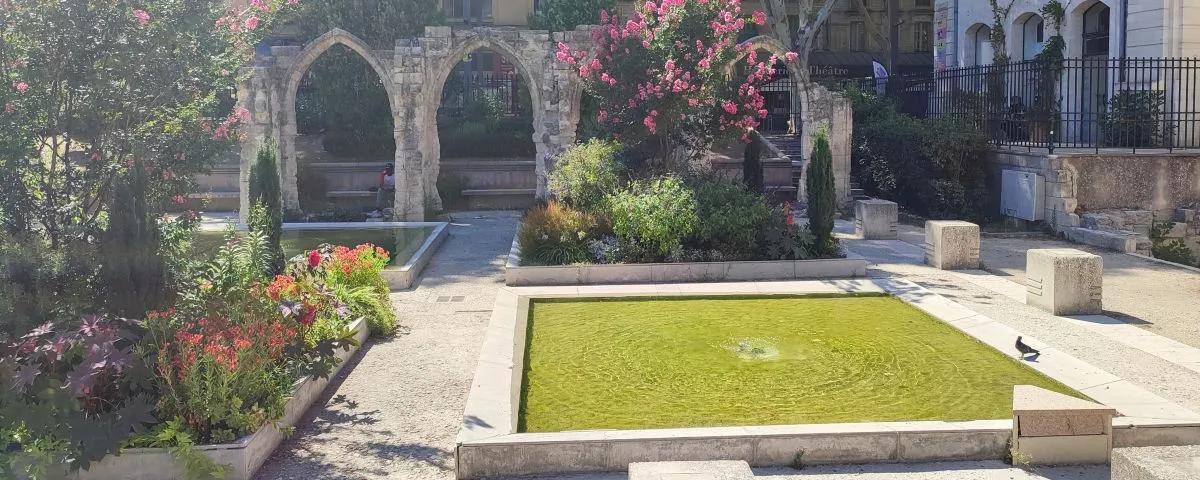
Just a few steps from Avignon’s busiest central streets, Square Agricol Perdiguier feels like someone has turned down the volume. Trees cast welcome shade, benches invite you to stop, and the garden offers a useful break between museums, churches, and the stone streets of the historic center.
What makes it interesting is not a single spectacular monument. Its appeal comes from the contrast between greenery and the dense medieval city around it. Tucked behind an old Gothic church that has since become a Protestant temple, the square has flower-lined ponds and small corners where it is surprisingly easy to forget that Rue de la République is close by.
We particularly like this kind of stop because it changes the rhythm of a visit. Avignon can be intense in summer, especially around the main sights. Here, you can sit for twenty minutes and simply enjoy being in Provence without needing another ticket or audioguide.
Come here when you need shade, calm, or a short reset rather than another major attraction.
2. Step Inside Saint-Didier Church

Saint-Didier is easy to pass without realizing how much is hidden behind its restrained façade. Built in the 14th century, the collegiate church is a fine example of southern Gothic architecture, with relatively few openings and a broad, sober character that feels very different from the theatrical scale of the Palais des Papes.
Inside, the building becomes considerably richer. Look for the 14th-century frescoes in the first chapel on the left, including an emotionally charged Descent from the Cross. On the opposite side, a marble relief of Christ carrying the Cross was commissioned by King René in the 15th century.
The single nave and pentagonal apse give the church a clear, uncluttered structure. This is not the sort of place that demands an hour. That is precisely why we recommend it. You can step in while crossing the old town and suddenly find yourself face to face with medieval works that many visitors never see.
For medieval art without the crowds, Saint-Didier is one of Avignon’s most rewarding short visits.
3. Discover the Collegiate Church of Saint-Agricol

Saint-Agricol is another reminder that papal Avignon extends well beyond its famous palace. The church stands quietly in the historic center, surrounded by everyday city life, cafés, narrow streets, and façades that make this part of Avignon particularly pleasant to explore on foot.
The present building combines Romanesque and Gothic elements and largely dates from the 14th century, on a site associated with a much older church. Saint-Agricol is worth visiting as part of a wider walk through medieval Avignon, rather than as an isolated attraction. Step inside, slow your pace, and pay attention to the proportions, side chapels, religious artworks, and the sense of continuity between the church and the neighborhood around it.
We recommend pairing it with Saint-Didier and Saint-Pierre. Seen together, the three churches tell a more nuanced story of the city than the major monuments alone can provide.
If your first visit to Avignon focused mainly on the Palais des Papes, Saint-Agricol helps fill in the quieter, parish-level history of the medieval city.
4. Admire the Basilica of Saint-Pierre

Saint-Pierre sits at the end of a particularly pleasant wander through old Avignon. The surrounding streets are part of the pleasure: historic townhouses, small squares, and the feeling that you have slipped away from the most obvious tourist circuit.
Then comes the façade. The late Gothic front and intricately carved wooden doors are the details to stop for, along with the slender 14th-century bell tower. The stonework is ornate without being overwhelming, especially when compared with the massive defensive character of the papal palace.
Do not rush straight through the door. Spend a few minutes outside first, because Saint-Pierre works as much as an architectural discovery as a religious one. Inside, the atmosphere is quieter, providing another glimpse of Avignon’s deep ecclesiastical heritage.
For us, this is exactly what an off-the-beaten-path stop should do: it turns an ordinary walk between major sights into a discovery of its own. If you enjoy architecture, Saint-Pierre deserves a place on your route.
5. Visit Saint-Symphorien Church
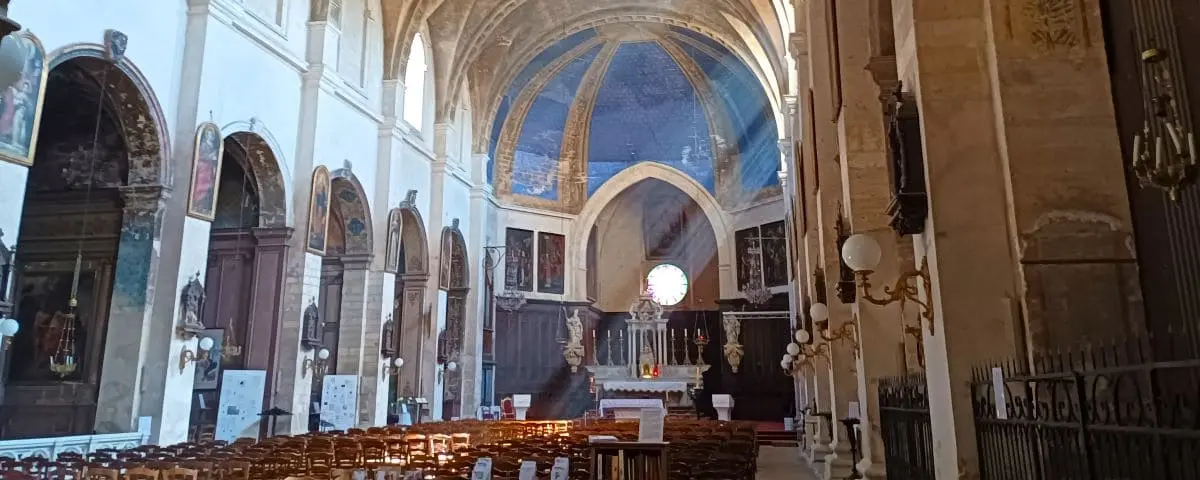
Around Place des Carmes, Avignon becomes noticeably more neighborhood-like. Terraces, trees, market life, and older buildings create a softer atmosphere than the grand spaces around the Palais des Papes. Saint-Symphorien fits naturally into that setting.
Known in full as Église Saint-Symphorien-les-Carmes, the Gothic church was built across the 13th and 14th centuries and presents a relatively simple façade. Visit Saint-Symphorien for the atmosphere of the Carmes district as much as for the building itself. It is the combination that makes this stop feel different.
This is a good place to resist the temptation to sightsee too efficiently. Wander around the square, look at the façades, sit for a coffee if the mood takes you, then enter the church when it is open. The experience is simple and pleasantly local.
If you are searching for non-touristy things to do in Avignon, the Carmes area is one of the easiest places to feel that you have stepped outside the standard itinerary.
Small Museums and Cultural Gems Most Visitors Miss
6. Explore the Musée Louis Vouland

Musée Louis Vouland is the sort of museum that makes sense precisely because it is small. Housed in an elegant private mansion, it presents the decorative arts collected by Louis Vouland, an Avignon collector with a particular taste for the 17th and 18th centuries.
Rooms are filled with furniture, tapestries, ceramics, marquetry, and objects that once belonged in domestic interiors rather than white museum galleries. The pleasure here comes from seeing a collection in a setting that still feels like a home. Faience from Provence and elsewhere, period seating, Aubusson and Gobelins tapestries, and a Chinese room create plenty of details to inspect.
There is also Provençal painting and a garden, which makes the museum a particularly pleasant change of pace after the city’s monumental Gothic heritage.
We would recommend Louis Vouland to travelers who enjoy interiors, craftsmanship, and decorative art more than blockbuster museums. Allow yourself to look slowly rather than trying to identify every object. The atmosphere is the real attraction.
7. See Ancient Art at the Musée Lapidaire
The Musée Lapidaire is unusual before you even look at the collection. It occupies a former Jesuit college chapel on Rue de la République, so ancient sculptures and archaeological objects are displayed beneath the architecture of a much later religious building.
That contrast works beautifully. Greek, Etruscan, and Roman objects gain an unexpected sense of drama in the chapel setting, while smaller everyday artifacts remind you that archaeology is not only about emperors, gods, and monumental statues.
The museum holds part of the archaeological collections associated with the Musée Calvet. It is compact enough to visit without museum fatigue, making it an excellent addition to a walking day in the historic center.
If antiquity interests you, this is one of the most distinctive hidden gems in Avignon. And even if archaeology is not normally your priority, the setting alone gives the museum character.
We would choose the Lapidaire when you want a short cultural stop that feels completely different from papal Avignon.
8. Discover Provençal Culture at the Palais du Roure

For travelers interested in Provence itself, not just Avignon’s papal history, the Palais du Roure is particularly valuable. The building is a 15th-century private mansion with close ties to the cultural movement that defended and celebrated Provençal language and traditions.
Frédéric Mistral gave the house its present name, and the place became associated with figures such as Folco de Baroncelli and Jeanne de Flandreysy. Inside, the focus shifts from grand political history to Provençal culture, literature, traditions, furnishings, and everyday identity.
The rooms retain the feeling of an inhabited historic house. Collections range from archaeology to regional arts and popular traditions, making the visit pleasantly difficult to classify. It is part museum, part cultural memory, part old Avignon residence.
That mixture is exactly why we like it for this itinerary. After palaces and churches, the Palais du Roure introduces a different question: what did Provence mean to the people who tried to preserve its culture?
If you want more than monuments, this is one of the most meaningful small museums in Avignon.
9. Explore Natural History at the Muséum Requien

After several days of Gothic stone, saints, popes, and paintings, a natural history museum may be the last thing you expect to find in central Avignon. That is part of its charm.
The Muséum Requien is small, old-fashioned in the best sense, and filled with objects linked to the natural history of Vaucluse and beyond. Fossils, minerals, silicified palm trunks, gypsum crystals, fossil bears from Mont Ventoux, and preserved animals completely change the subject.
Families can enjoy it, but you do not need children as an excuse to visit. The museum provides a reminder that Provence is not only a cultural landscape. Its mountains, rocks, fossils, vegetation, and geological history are just as much part of the region’s identity.
Because it is modest in scale, the Requien works best as a spontaneous stop rather than the centerpiece of your day.
Choose it when you want the most unexpected museum on this list, especially after several history-heavy visits.
How to Explore These Avignon Hidden Gems
Can You Visit These Places on Foot?
Yes. Walking is the best way to connect these unusual places because almost all of them sit within Avignon’s compact historic center. The distances are short, but the streets themselves are part of the experience, with old façades, small squares, passages, and unexpected views appearing between stops.
A useful approach is to use our Avignon tourist map to group the sights geographically rather than following the list in numerical order. You can combine the churches on one loop, then visit the museums around Rue de la République and Rue Joseph Vernet.
For a broader overview before you start, our guide to the best things to do in Avignon places these quieter stops alongside the city’s essential monuments.
Do not over-plan the route. Avignon rewards small detours.
How Much Time Do You Need?
You could see several of these places in a single day, but trying to visit all nine would turn an off-the-beaten-path experience into a checklist. We suggest choosing three to five according to your interests, then leaving room for lunch, a terrace, and aimless wandering.
If you only have one full day, start with our one-day Avignon itinerary and add one or two hidden gems near your main route. With two days, it becomes much easier to devote half a day to the churches and another to the smaller museums.
Travelers still deciding how long to stay may also find our guide on whether Avignon is worth visiting useful.
The goal is not to see everything. It is to give yourself enough time to notice the city between the attractions.
When Is the Best Time to Explore Avignon Off the Beaten Path?
Spring and early autumn are especially pleasant for walking, but these hidden places are useful in almost any season. Churches and museums offer shelter on hot, windy, or rainy days, while Square Agricol Perdiguier comes into its own when you simply need shade.
July is different. The Festival transforms Avignon, filling streets and squares with performers, posters, and visitors. It is an extraordinary time to be in the city, but any definition of “off the beaten path” becomes relative during the Festival. Early mornings can still feel surprisingly peaceful.
If Avignon forms part of a wider Provence trip, compare Avignon or Aix-en-Provence and Arles or Avignon to decide which atmosphere best fits your route.
Staying longer also opens up excellent day trips from Avignon across Provence.
FAQ About Unusual Things to Do in Avignon
What Are the Best Hidden Gems in Avignon?
For a first alternative itinerary, we would combine Saint-Pierre, Saint-Didier, the Palais du Roure, and Musée Louis Vouland. Together they offer Gothic architecture, medieval art, Provençal culture, and decorative arts without repeating the experience of the Palais des Papes.
If you prefer something less conventional, swap one of the churches for the Muséum Requien. Travelers interested in antiquity should prioritize the Musée Lapidaire.
The important thing is to match the hidden gems to your interests. “Unusual” does not necessarily mean obscure or eccentric. In Avignon, it often means a place of real historic value that simply receives less attention than the city’s famous monuments.
What Can You See in Avignon Beyond the Palais des Papes?
Quite a lot. The historic center contains medieval churches, private mansions, gardens, archaeological collections, natural history displays, and museums devoted to decorative arts and Provençal traditions.
The best alternative to another major monument is simply to walk through the old town with a few smaller destinations in mind. Saint-Pierre and Saint-Didier work beautifully for architecture, the Palais du Roure for regional culture, and the Lapidaire for archaeology.
This approach also reveals streets and squares you might otherwise miss. In Avignon, the journey between two places is often almost as rewarding as the places themselves.
Are There Free Unusual Things to Do in Avignon?
Yes. Walking the historic center, relaxing in Square Agricol Perdiguier, and entering churches when they are open can make an excellent low-cost itinerary. Some municipal cultural sites may also offer free access, although opening arrangements and admission policies can change, so it is worth checking before your visit.
You do not need a packed museum schedule to discover hidden Avignon. A slow walk through the Carmes district, a visit to Saint-Pierre, and twenty quiet minutes in a garden can reveal more of the city’s personality than rushing between paid attractions.
For budget-conscious travelers, focus on neighborhoods and short cultural stops rather than trying to maximize the number of ticketed sights.
Wrap-Up: Discover a Different Side of Avignon
- Start with the famous monuments, then give the quieter side of Avignon at least half a day.
- For architecture, prioritize Saint-Pierre, Saint-Didier, and Saint-Agricol.
- For an atmospheric neighborhood experience, combine Saint-Symphorien with a wander around the Carmes district.
- For culture, choose Palais du Roure for Provence, Louis Vouland for decorative arts, and Lapidaire for antiquity.
- For something completely different, Muséum Requien is the most unexpected stop on the list.
- Above all, walk rather than rushing from attraction to attraction. Avignon’s hidden places make the most sense when discovered as part of the old town itself.