


PRESENTATION
Much More Than Just the Area Around Paris
Paris sits at the centre of the map and attracts almost all the attention. But as soon as you cross the city limits, you discover a much larger region, where modern neighbourhoods quickly give way to former royal residences, historic towns, dense forests and farmland. The Paris region, known as Île-de-France, is not simply a collection of suburbs surrounding Paris. It is a region in its own right, shaped by centuries of history and a surprisingly wide range of landscapes.
Covering around 12,000 square kilometres, it is the smallest region in mainland France, but also the most populated. More than 12.4 million people live here, which is almost one in five people in France. Most of the population is concentrated around Paris and the large towns nearby. Further out, the scenery can change within just a few train stops. Buildings become less frequent, fields begin to appear and church towers once again dominate the skyline.
So do not be misled by the urban density around the capital. Farmland, forests and natural areas still cover a large part of the region. Some places even feel a long way from Paris, despite being less than an hour away by train. This makes it easy to combine several different experiences in one day, visiting a palace in the morning, walking through a forest in the afternoon, then returning to the capital in the evening.
Île-de-France is ideal for short day trips, but it is also worth exploring over several days. Distances are manageable, public transport serves many of the main attractions and each direction reveals a different side of the region. You do not have to travel hundreds of kilometres to move from a highly urban landscape to a wooded valley, or from a business district to a town surrounded by medieval walls.
Châteaux, Historic Towns and Royal Heritage
For several centuries, political power in France was centred around Paris. Kings, members of the royal court and powerful families built an extraordinary number of palaces, châteaux and estates across the region. There are said to be around 260 of them, ranging from medieval fortresses to elegant residences surrounded by gardens.
Versailles is, of course, the best known. Originally a hunting lodge, it was transformed into an enormous royal residence and became an architectural model copied across Europe. Its state apartments, Hall of Mirrors, formal gardens and vast grounds show just how power was once displayed here. The palace and its park are now listed as a Unesco World Heritage Site.
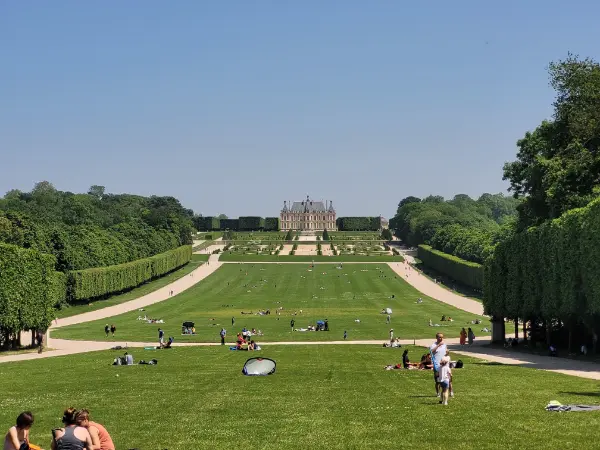
But Versailles should not overshadow everything else. The Château de Fontainebleau has an even longer history and was expanded over the centuries by different rulers, each adding their own style. At Vaux-le-Vicomte, the balance between the architecture, interior decoration and gardens anticipated the grand designs of the late seventeenth century. Quieter estates, such as Saint-Cloud and Sceaux, offer a glimpse into aristocratic life in settings that are often far less crowded.
The region is also home to several towns with histories of their own, independent of Paris. Provins, with its walls, fortified gates and medieval buildings, recalls a time when major trading fairs attracted merchants from all over Europe. In Saint-Denis, the basilica contains the tombs of many French monarchs and is one of the most important monuments for understanding the origins of Gothic architecture.
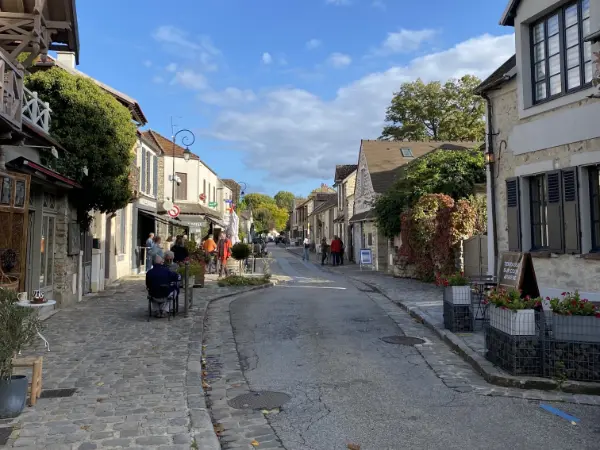
Other towns are appealing not because of one famous monument, but because of their atmosphere. The old streets of Montfort-l’Amaury, the houses of Moret-sur-Loing and the dramatic setting of La Roche-Guyon, overlooked by a fortress built into the cliffs, are perfect for walks that can easily be combined with a day in the countryside. Just a few kilometres from the most heavily urbanised areas, you can still find quiet squares, narrow lanes and peaceful riverbanks where time seems to slow down.
Forests, Valleys and Villages Near the Capital
It is hard to believe that the entire region is covered in roads and buildings once you have walked through the Forest of Fontainebleau. This vast woodland is known for its sandstone boulders, sandy paths and landscapes that were popular with nineteenth century painters. Today, it is one of the main destinations for hiking and climbing near Paris. Several nearby villages have kept their traditional character, including Barbizon, which is associated with a generation of artists who came here to work directly in nature.
Further west, the Chevreuse Valley is made up of wooded hills, small rivers, historic abbeys and villages built around churches or châteaux. The walking trails cross peaceful landscapes that feel completely different from the busy capital. In the Seine Valley, limestone cliffs, islands and the river’s wide bends create another kind of scenery, particularly around La Roche-Guyon.
Water also plays an important role in shaping the region. The Seine crosses the area in a series of broad loops, while the banks of the Marne have long been popular for Sunday walks and leisure activities. Smaller rivers flow past old mills, gardens and historic villages. These landscapes inspired many artists, who were drawn by the reflections on the water, the changing light and the fact that the area was so easy to reach from Paris.
Île-de-France also offers some surprising changes of scenery. You can see historic aircraft at Le Bourget, walk through a garden created around botanical collections, follow a path between giant rocks or visit a medieval village before taking the train home. This constant variety is what gives the region its character. It is monumental without feeling uniform, heavily populated but still largely open, close to Paris while offering plenty of opportunities to escape.
OVERVIEW
Map
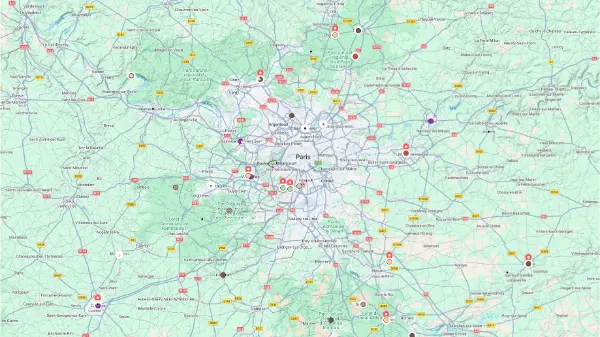
Interactive Map
Interactive Map
Click on the icon  in the top-left corner to display the map legend.
Show/Hide layers as needed.
Click on the arrow icons (v) to display the sublayers.
Top Picks