


PRESENTATION
Valleys, Cliffs, and the Footprints of Early Humans
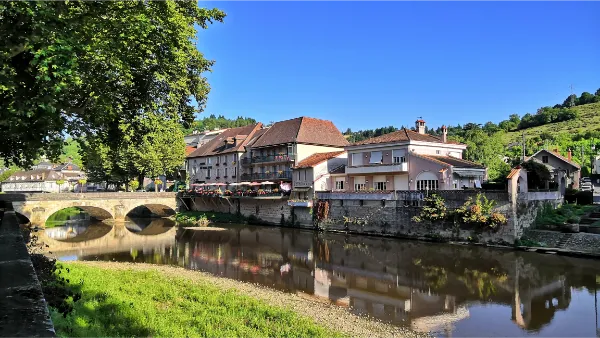
The region first reveals itself through its landscapes. Rivers have slowly shaped the land here, creating a winding territory where roads follow the water, villages appear around bends, and viewpoints open up around every meander. Nothing feels truly monumental at first glance, yet everything seems carefully arranged: wooded hills, meadows, old bridges, pale stone houses, and peaceful riverbanks.
These valleys set the natural pace of the journey. You move through them without any real sense of urgency, often alongside the water, with the feeling that every turn might reveal a cliff, a village, or a castle. Canoe trips and traditional boat rides offer a different perspective on the landscape. From the river, the heights seem more dramatic, the villages more tightly packed, and the castles more strategically placed. The scenery is not just beautiful, it helps explain how people settled here in the first place.
The cliffs provide the region’s second great backdrop. They are far more than scenery. They tower above the roads, shelter villages, hide caves, and create spectacular viewpoints. In Rocamadour, houses and sanctuaries seem to cling to the rock face in an almost unreal balance. In Saint-Cirq-Lapopie, the houses climb the hillside, creating one of the area’s most striking silhouettes. Elsewhere, limestone walls line the rivers and give the journey a wilder, more vertical character.
This constant presence of rock naturally leads to the underground world. Gouffre de Padirac is perhaps the most spectacular example. Visitors descend into a vast natural opening before reaching galleries, underground rivers, and remarkable mineral formations. The scale of the journey changes completely. After the open valleys and visible cliffs, you discover a hidden, silent, almost abstract landscape where water has shaped stone over immense spans of time.
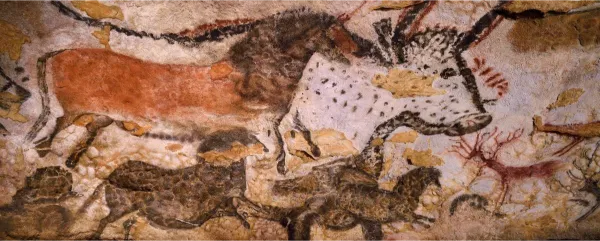
It’s also within this setting of valleys, cliffs, and natural shelters that prehistory comes into focus. The region is one of Europe’s great destinations for understanding early human history. Caves, rock shelters, and decorated sites reveal an exceptionally ancient human presence. Lascaux remains the most famous name, thanks to its animal paintings discovered in the twentieth century, but it’s only part of the story. Other caves and shelters offer insight into the lives, skills, and imagination of the people who inhabited these landscapes long before today’s towns, castles, and roads existed.
Pech Merle offers another glimpse into this distant past. Its paintings show that these communities did far more than survive in a demanding environment. They observed animals, worked with the natural shapes of the rock, and transformed cave walls into images. This aspect gives the journey a rare sense of depth. You are not simply travelling through beautiful French countryside, you are exploring a land where nature and humanity’s earliest traces remain closely connected.
Centuries of History Among Stone Villages and Castles
Beyond its distant origins, the region is defined by a medieval history that remains highly visible today. Hills, river crossings, bridges, and valleys all held strategic importance for centuries. Villages were built for protection, castles watched over roads and waterways, and religious sites drew pilgrims and travellers. This history does not feel like an abstract chapter in a book. It can still be read directly in the streets, walls, towers, and hilltop silhouettes.
The Middle Ages left a particularly strong mark on the area’s identity. Rocamadour offers a spectacular example, with its layered houses and sanctuaries pressed against the cliff face. Cahors preserves a great fortified bridge, ancient lanes, and a cathedral that reflect its historical importance. Figeac presents a different atmosphere, more urban in character, with historic houses and strong links to the history of writing. In all these places, the past is not confined to museums, it still shapes the structure of the town itself.
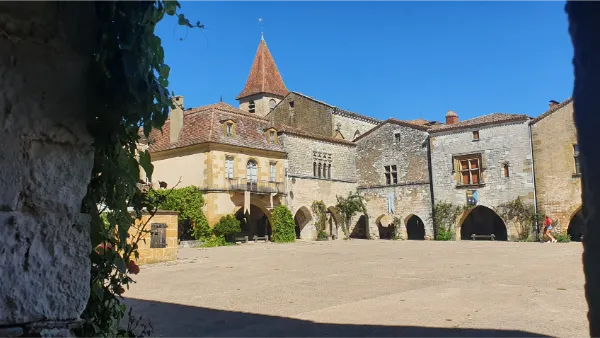
The many stone villages extend this feeling. They are often compact, built from pale or golden stone, with narrow streets, covered passageways, steep roofs, and houses clustered closely together. Some overlook rivers, others nestle beneath cliffs, while others are organised around central squares. Their charm comes from their unity. The landscape, the stone, and the architecture all seem to belong to the same design.
Saint-Cirq-Lapopie, Loubressac, Autoire, Carennac, Martel, La Roque-Gageac, Beynac-et-Cazenac, Domme, and Monpazier each offer their own variation on this setting. It’s best not to see them simply as a collection of pretty villages. What makes them fascinating is how each one responds to its location. One overlooks a river, another occupies a rocky promontory, another fits between a cliff and a valley, while another reflects the more regular layout of a medieval fortified town.
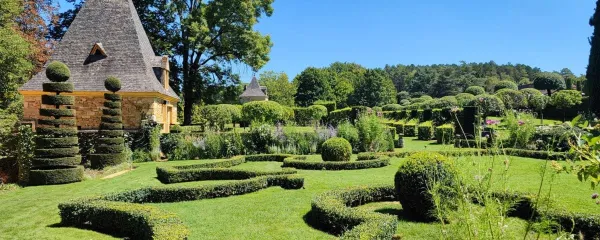
Castles provide the final major historical backdrop to the journey. Some remain true fortresses, built for surveillance and defence. Others gradually evolved into more elegant residences over the centuries. Château de Castelnaud and Château de Beynac evoke a history of rivalries and defensive strongholds, their powerful silhouettes dominating the valley below. Château de Hautefort and Château des Milandes present a more refined and stately image of castle life.
This combination of villages, castles, and historic towns gives the destination its richness. The journey is not built around a single great monument, but around continuity. One road leads from a bridge to an old square, from a narrow lane to a panoramic terrace, from a castle to a garden, from a hilltop village to a peaceful valley. It’s this succession of discoveries that makes the region so rewarding to explore.