




Intro: See the Side of Aix Most Visitors Walk Past
Aix-en-Provence is easy to love at first sight. The fountains, café terraces, ochre façades and elegant Cours Mirabeau deliver exactly the Provençal atmosphere many travelers come looking for. But the city becomes more interesting when you start looking beyond its most photographed streets.
If you have already covered the main things to do in Aix-en-Provence, these seven places offer a more unexpected route through the city. Think optical art, discreet private mansions, overlooked museums, quiet churches and a park where Aix feels refreshingly local. None requires turning your trip into an expedition. Most fit naturally into a walk through the center.
7 Unusual Places in Aix-en-Provence at a Glance
- Fondation Vasarely is the boldest choice if you want architecture and art that feel completely different from historic Aix.
- Hôtel de Gallifet combines contemporary art with an intimate mansion setting, making it one of the city’s most pleasant under-the-radar cultural stops.
- Musée du Vieil-Aix is best for understanding old Aix from the inside, through objects, interiors and local traditions rather than grand monuments.
- Musée des Tapisseries rewards travelers who enjoy decorative arts and historic buildings, with the former Archbishop’s Palace adding as much interest as the collection.
- Église Saint-Jean-de-Malte offers one of Aix’s strongest Gothic contrasts, particularly after the softer Baroque streets around the Mazarin Quarter.
- Église du Saint-Esprit is easy to miss but worth stepping inside, especially if you enjoy discovering churches hidden in the everyday fabric of a city.
- Parc Jourdan is the least monumental stop and perhaps the most local, ideal when you need shade, space and a slower hour away from sightseeing.
Discover a Different Side of Aix-en-Provence
1. Discover the Optical World of the Fondation Vasarely
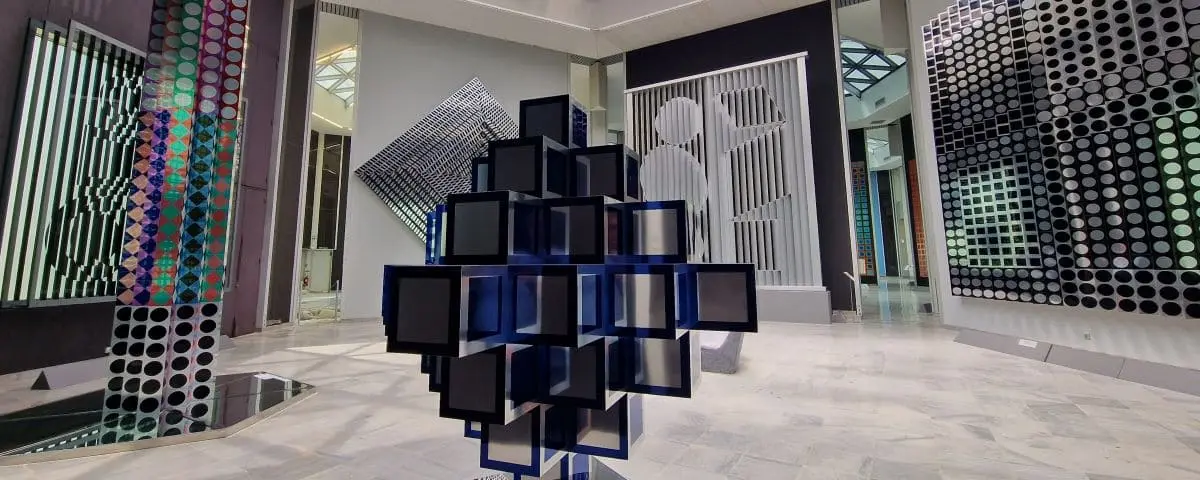
Aix usually means Cézanne. The Fondation Vasarely abruptly changes the visual language. Located outside the tight historic core in Jas de Bouffan, the building belongs unmistakably to another Aix, one shaped by 20th-century experimentation rather than fountains and hôtels particuliers.
Victor Vasarely imagined the foundation as more than a conventional museum. Its architecture and monumental works were conceived together, creating an environment of geometric patterns, shifting perspectives and intense optical effects. This is not simply a place where art hangs on walls. The building itself forms part of the experience.
That contrast is precisely why we include it among the best unusual things to do in Aix-en-Provence. After a morning among limestone façades and narrow streets, its large-scale Op Art compositions can feel almost futuristic.
Take your time rather than trying to “understand” every piece. Move around, change angles and let your eyes do the work. For art lovers, photographers and anyone suffering from Cézanne fatigue, Vasarely is the clearest break from the classic Aix itinerary.
It is also the one stop on this list that sits noticeably away from the central sightseeing circuit, so plan it deliberately rather than hoping to stumble across it.
2. See Contemporary Art at the Hôtel de Gallifet
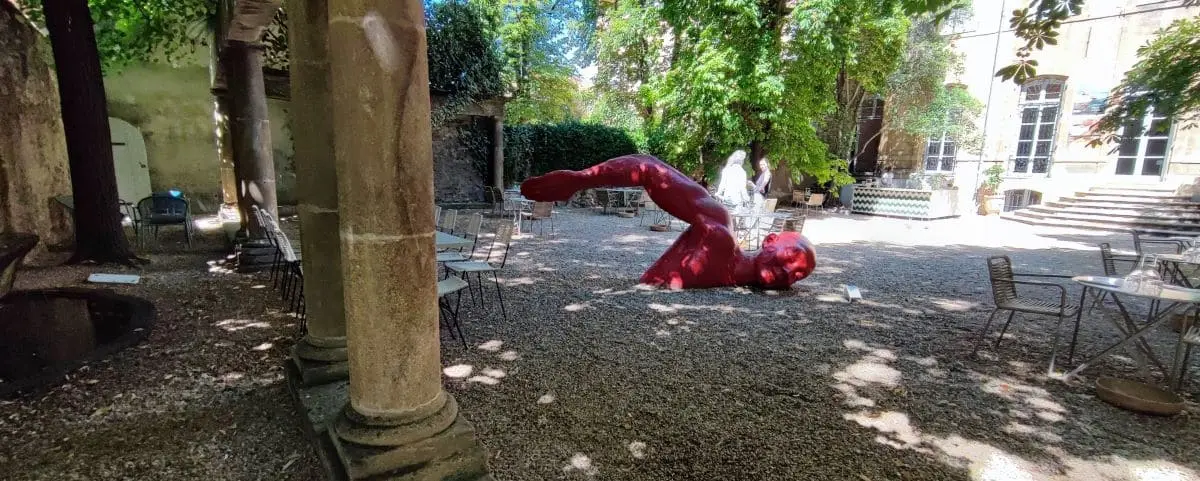
Back in the Mazarin Quarter, the Hôtel de Gallifet provides a completely different contemporary-art experience. The setting is an elegant 18th-century private mansion, the sort of building you might normally admire from the street before moving on.
Here, you get to step inside.
Temporary exhibitions occupy the historic spaces, while the courtyard and garden soften the formality of the architecture. The result is less institutional than a large museum. Gallifet feels like discovering an art address hidden inside one of Aix’s aristocratic houses.
That makes it particularly well suited to travelers who like culture but do not want another long museum visit. We especially like Gallifet as a counterpoint to the polished streets around Place des Quatre-Dauphins.
Come for the contemporary art, but pay attention to the mansion, courtyard and transition between indoors and outdoors. That dialogue between old Aix and current creation is what makes this place more memorable than a standard gallery stop.
3. Step Into Local History at the Musée du Vieil-Aix

The Musée du Vieil-Aix is not the museum for blockbuster paintings or monumental archaeology. That is exactly the point.
Installed in the Hôtel d’Estienne-de-Saint-Jean on Rue Gaston-de-Saporta, it explores the life, traditions and decorative culture of the city through a collection that feels distinctly local. If you want to understand what old Aix looked and felt like behind its façades, this is one of the most revealing places to visit.
The setting deserves attention in its own right. A monumental staircase, painted ceilings and period details transform the visit into a look inside one of the historic residences that give central Aix so much of its character.
Among the more unusual objects is the painted screen associated with the Fête-Dieu, whose panels preserve a remarkably detailed vision of a celebration rooted in the city’s past. Puppets, faience, furniture and other pieces add smaller fragments to the picture.
Its charm lies in details, curiosities and the sense of entering the city’s memory room. It is also conveniently placed for following an Aix-en-Provence tourist map through the historic center.
4. Discover the Musée des Tapisseries
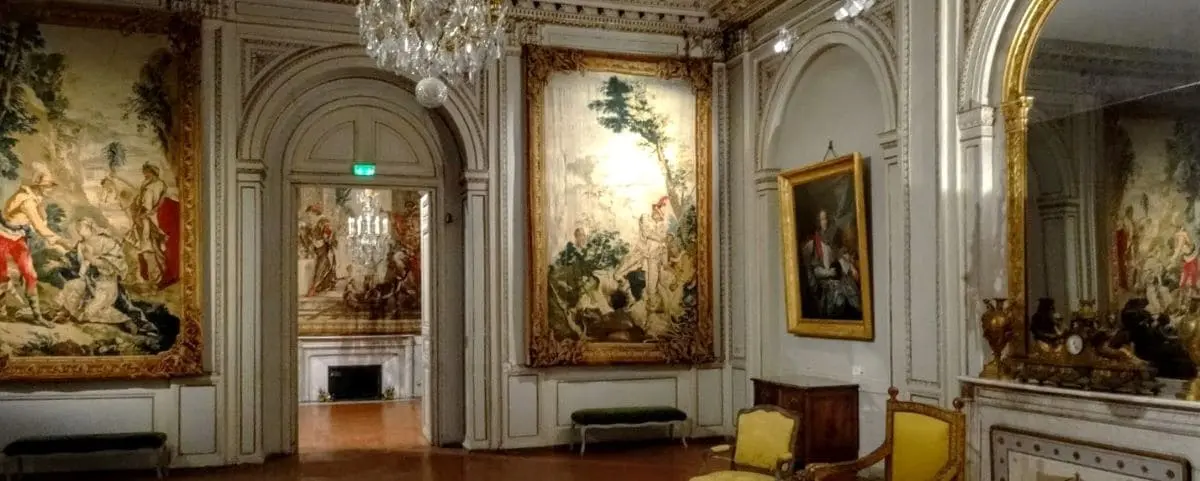
The Musée des Tapisseries sits inside the former Archbishop’s Palace, just beside the cathedral area. Many visitors pass nearby without considering it, which is part of its appeal for anyone looking for lesser-known places in Aix-en-Provence.
The museum’s historic rooms provide the first surprise. Grand staircases, decorative plasterwork and ceremonial interiors recall the building’s long connection with the archbishops of Aix and distinguished visitors. Here, the palace is not merely a container for the collection. It is half the reason to go.
Then come the tapestries themselves. The collection includes large decorative works from the 17th and 18th centuries, including theatrical compositions and scenes connected with Don Quixote. Seen in these interiors, they make much more sense than they would in a neutral gallery.
This is not a museum we would recommend to everyone. If tapestries and decorative arts leave you cold, there are stronger priorities in Aix. But for travelers interested in craftsmanship, historic interiors or places that remain quieter than the headline attractions, the Musée des Tapisseries is a genuine hidden gem rather than a box-ticking stop.
It also pairs naturally with the Musée du Vieil-Aix, allowing you to explore two different expressions of historic Aix without crossing the whole city.
5. Visit the Gothic Église Saint-Jean-de-Malte

At the edge of the Mazarin Quarter, Saint-Jean-de-Malte rises with a severity that feels almost surprising in Aix. Its tall profile and Gothic character offer a sharp contrast with the city’s more familiar classical façades.
The church dates from the medieval period and is often described as an important early example of Gothic architecture in Provence. Inside, the impression is restrained rather than lavish. The high nave, relative simplicity and sense of vertical space are the attraction here.
First stand back and take in the proportions. After the decorative exuberance found elsewhere in Provence, the sobriety can be refreshing. It also sits beside the Musée Granet and close to the Mazarin Quarter, so it slips easily into a central walk.
We would treat it as a short, atmospheric pause rather than a major standalone visit. Ten quiet minutes here can be more memorable than another half-hour spent chasing landmarks.
6. Step Inside the Église du Saint-Esprit
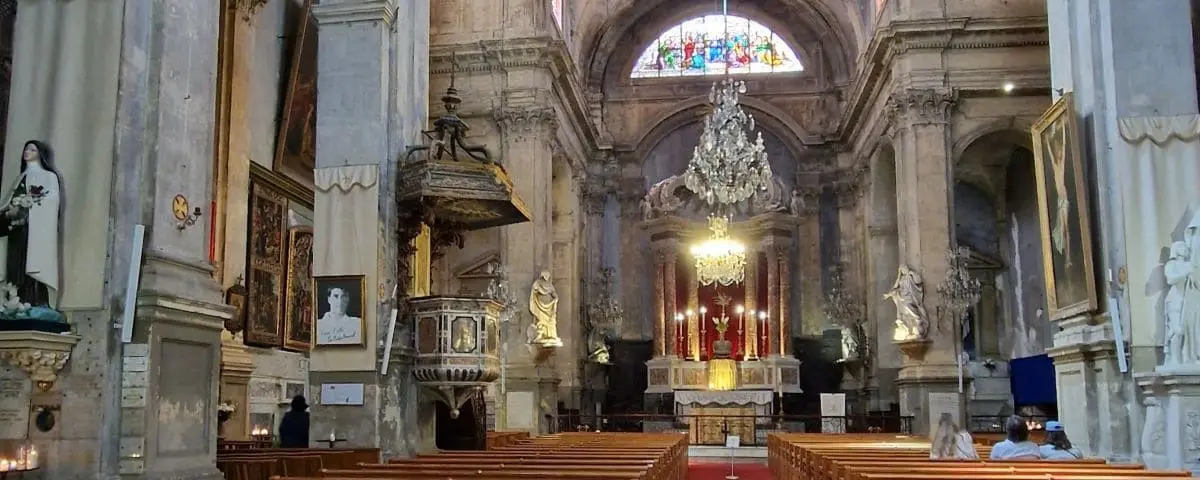
The Église du Saint-Esprit demonstrates one of our favorite rules for exploring French cities: when an old church appears almost swallowed by surrounding streets and shops, take a look inside.
Located in central Aix, it does not announce itself with the same monumental presence as Saint-Jean-de-Malte. The exterior can be passed surprisingly easily. The pleasure comes from moving from an ordinary shopping street into a much richer religious interior.
This is where the notion of “unusual” matters. You are not traveling across Provence to see a famous monument. You are noticing something many visitors walk past while moving between better-known sights.
The church belongs to the Baroque side of Aix, with a more decorative atmosphere than Saint-Jean-de-Malte. Together, the two make an interesting pair precisely because they feel so different.
If you enjoy slow travel, architecture or simply opening doors that look promising, put it on your route. Saint-Esprit works best as a discovery rather than a destination, a 10-to-20-minute interruption that adds texture to a day in the center.
It is this kind of small encounter that often answers the question of whether Aix-en-Provence is worth visiting: the city rewards curiosity between the headline sights.
7. Take a Local Break in Parc Jourdan
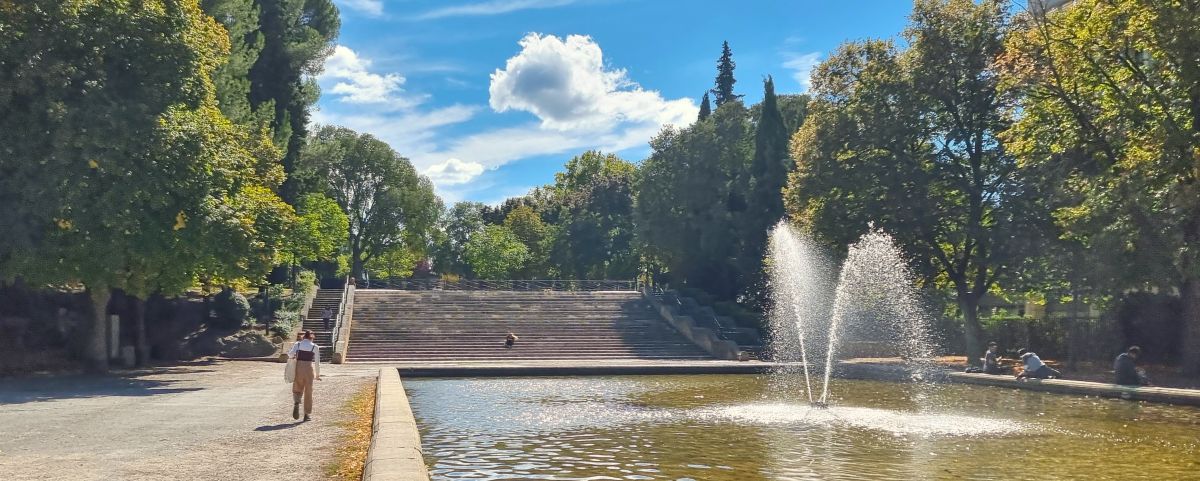
Not every unusual place needs stained glass, a collection or an admission desk. Parc Jourdan earns its place precisely because it offers something different: ordinary Aix life.
A short walk south of the historic center, the park provides lawns, mature trees, paths and enough space to slow down after several hours on stone streets. Come here when you want to stop sightseeing without feeling that you have stopped experiencing the city.
Students, families, walkers and people simply taking a break give the park a local rhythm. It is not a manicured palace garden competing for your camera. That is part of the charm.
We would not cross Aix solely to tick Parc Jourdan off a list. Instead, use it intelligently. Pick up something for lunch, sit in the shade, read for a while or give children room to move. On a hot day, that pause can be worth more than squeezing in another museum.
Parc Jourdan is best understood as a breathing space in your itinerary. If the first six places reveal alternative cultural sides of Aix, this one reveals how pleasant the city can be when you stop trying to “visit” it.
How to Fit These Unusual Places Into Your Aix-en-Provence Visit
Which Places Can You Easily Combine on Foot?
Six of the seven places work well within or close to the central walking area. A logical route can connect the Musée du Vieil-Aix and Musée des Tapisseries in the northern old town, continue toward Saint-Esprit, then cross Cours Mirabeau toward Gallifet and Saint-Jean-de-Malte before finishing at Parc Jourdan.
Fondation Vasarely is the exception and deserves its own detour. Build it into the beginning or end of the day rather than forcing it into a compact old-town walk.
If this is your first visit, do not replace all the classics with hidden gems. Mix them. Our one-day Aix-en-Provence itinerary is a better base when time is tight, while a two-day itinerary gives you much more freedom to add Vasarely, Gallifet or the smaller museums.
How Much Time Should You Allow?
You do not need a separate day for these seven places. Allow roughly half a day for a selective route, or spread them across two days alongside Aix’s major sights.
Vasarely deserves the longest dedicated slot because of its location and scale. Gallifet and the two museums can vary depending on exhibitions and your interest. The churches may take only 10 to 20 minutes each, while Parc Jourdan is entirely up to you.
Choose according to your interests: Vasarely and Gallifet for art, the two museums for local history, and the churches for architecture.
And if Aix is your base for several days, save time for the region too. Some of Provence’s strongest experiences sit outside the city, and our guide to the best day trips from Aix-en-Provence can help you decide when to leave the old town behind.
Wrap-Up: Explore Aix-en-Provence Beyond the Usual Sights
- Choose Fondation Vasarely for the biggest visual surprise, especially if you want something far removed from traditional Provençal imagery.
- Pair Gallifet with Saint-Jean-de-Malte and the Mazarin Quarter for an easy mix of contemporary art, architecture and elegant streets.
- Combine the Musée du Vieil-Aix with the Musée des Tapisseries if local history and historic interiors matter more to you than famous masterpieces.
- Use Saint-Esprit as a spontaneous central stop, not as a visit that needs to dominate your schedule.
- Finish with Parc Jourdan when your itinerary needs breathing room, particularly on a warm afternoon.
- Above all, treat these unusual things to do in Aix-en-Provence as additions to the city, not substitutes for it. Aix is at its best when grand sights, small discoveries and aimless wandering all share the same day.