




Intro: Antibes Beyond the Obvious

Antibes is easy to love for its ramparts, Picasso Museum, Provençal market and blue Mediterranean views. But the town becomes more interesting when you step away from the obvious stops. These unusual things to do in Antibes reveal a quieter, more local and sometimes slightly eccentric side of the city, from tiny museums and overlooked walks to a richly decorated chapel and a pocket garden most visitors simply pass by.
If you prefer places with fewer tour groups, start here.
9 Unusual Things to Do in Antibes at a Glance
- Promenade du Ponteil: choose this easy seafront stroll for open Mediterranean views without committing to a long hike.
- Sentier du Fort Carré: walk beside Saint-Roch cove for a different angle on the fortress, marina and coastline.
- Marché à la Brocante: browse an open-air mix of second-hand finds, decorative objects and local creations on Place Nationale.
- Musée de la Carte Postale: see the French Riviera through vintage postcards and the everyday life they recorded.
- Musée d’Archéologie: dig into the Greek and Roman past of Antipolis inside the Bastion Saint-André.
- Musée Peynet: discover a small, playful museum devoted to Raymond Peynet and humorous drawing.
- Espace Culturel Les Arcades: add a quick dose of contemporary art to an Old Town walk, usually without an admission fee.
- Chapelle Saint-Bernardin: step behind a discreet Old Town facade to find one of Antibes’ most surprising interiors.
- Jardin René Cassin: slow down among mature Mediterranean and exotic trees near the town center.
For the bigger picture, our Antibes tourist map makes it easier to see how these stops fit around the Old Town, the port and the seafront.
Discover the Hidden Side of Antibes
These places are not meant to replace the major attractions. As former France travel planners, we value small detours that add texture to a day in Antibes instead of simply adding more boxes to tick. For the classics first, see our complete guide to things to do in Antibes.
1. Promenade du Ponteil: Take a Quieter Seafront Walk

The Promenade du Ponteil does not have the drama of the Cap d’Antibes coastal trail or the historic weight of the old ramparts. It is much simpler than that, and its simplicity is exactly why it works.
Running beside Plage du Ponteil, the promenade gives you an uncomplicated walk right next to the Mediterranean, with broad views and plenty of sea air. There is no monument to tick off and no museum timetable to watch. You just walk, look across the water and let Antibes slow down a little.
We particularly like it between the Old Town and the beaches toward Cap d’Antibes, especially early in the morning or late in the day.
This is an urban seafront promenade, not a secret wilderness. Come for the breathing space, not for a blockbuster attraction, especially after several hours in the narrow streets of Vieil Antibes.
2. Sentier du Fort Carré: Follow a Lesser-Known Coastal Path
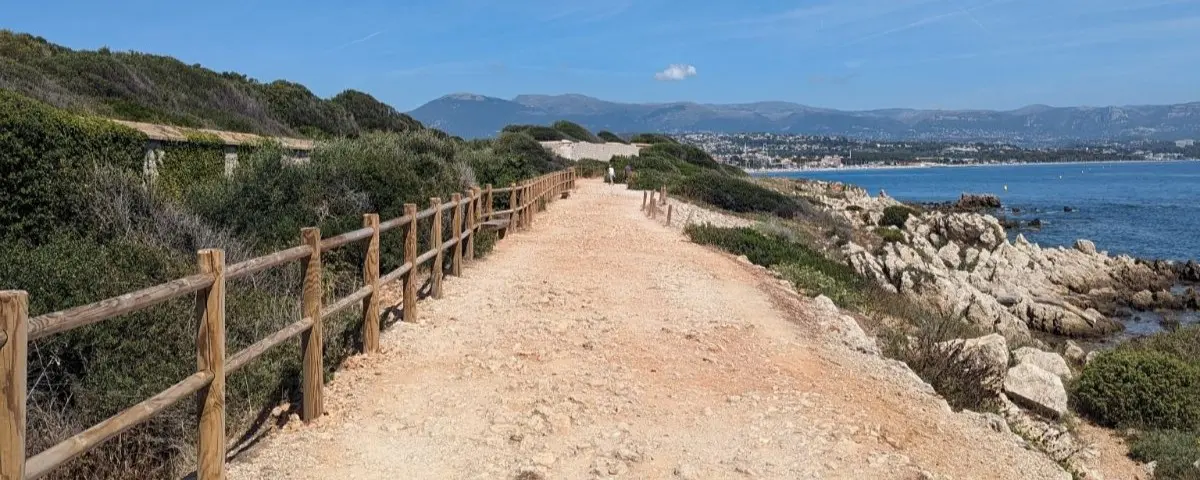
Fort Carré itself is hardly secret, but many visitors look at it from Port Vauban and never explore the quieter shoreline around it. The Sentier du Fort Carré, also referred to as part of the sentier du littoral, follows the Saint-Roch cove and gives the fortress a completely different setting.
Here, the pleasure comes from seeing military stone, marina masts and Mediterranean water in the same frame. The walk feels removed from the commercial lanes of the Old Town, even though central Antibes is close by.
From this side, it becomes obvious why the fort occupied such a strategic position above the port and coast. You also get a less polished view of Antibes, shaped by shoreline and harbor.
Combine the path with Port Vauban rather than making a special trip for it alone. For walkers, photographers and repeat visitors, it is one of the easiest ways to see an off-the-beaten-path side of Antibes.
3. Marché à la Brocante: Browse Antibes’ Flea Market

Most first-time visitors head straight for the food stalls of the Marché Provençal. A different atmosphere takes over at the Marché à la Brocante on Place Nationale, traditionally held on Thursdays and Saturdays.
The pleasure here is in rummaging. You may find decorative objects, ceramics, paintings, jewelry and second-hand pieces that feel much more personal than standard Riviera souvenirs. Some stalls lean toward traditional brocante, others toward local craft and small decorative treasures.
Do not arrive with a fixed shopping list. Wander slowly and see what turns up. Even if you buy nothing, the market adds a local rhythm to the square and contrasts nicely with Antibes’ polished marina.
It requires almost no extra planning if you are already in the Old Town. Pair it with Musée Peynet or Saint-Bernardin chapel.
Go if you enjoy browsing and atmosphere more than guaranteed finds. And because market schedules can change, especially around holidays or special events, confirm the day before building your itinerary around it.
4. Musée de la Carte Postale: See the Riviera Through Old Postcards

A museum devoted to postcards sounds wonderfully old-fashioned. That is part of its charm. The Musée de la Carte Postale uses these small pieces of printed paper to tell much bigger stories about travel, fashion, landscapes, social habits and the rise of the French Riviera as a destination.
Vintage cards reveal places before modern development, seaside scenes from another era and the visual language once used to sell the Côte d’Azur dream. What looks at first like a niche collection quickly becomes a miniature social history of tourism and everyday life.
For travelers who like unusual museums, it is compact yet distinctive enough to feel completely different from Antibes’ better-known art collections.
You do not need to be a collector. Look at clothes, signs, streets, hotels and beaches as carefully as the images themselves. They show how places and travelers change.
If you are wondering whether Antibes is worth visiting, museums like this strengthen the case for spending more than a quick lunch stop here. Antibes has layers beyond Picasso, beaches and yachts, and this little museum proves it.
5. Musée d’Archéologie: Discover Ancient Antipolis

Before Antibes became a Riviera resort, it was Antipolis. The Musée d’Archéologie takes you back toward those Greek and Roman roots from an appropriately solid setting, the Bastion Saint-André on the seafront.
Inside, the collection brings together archaeological finds from Antibes and the surrounding area, including amphorae, ceramics, mosaics and objects connected with daily life and maritime trade. The museum makes the ancient city feel less abstract by showing what people used, carried, traded and left behind.
The setting matters too. Inside a former defensive bastion, military and ancient history overlap, while the nearby Mediterranean connects the collection to the sea routes that shaped Antibes.
We recommend it to archaeology lovers and anyone wanting historical context before wandering the Old Town. It is a small museum, so do not expect the Louvre of the Riviera.
Come for a focused, atmospheric introduction to Antipolis and for the pleasure of finding archaeology in an unexpected corner of the waterfront. It fits especially well into a one-day Antibes itinerary when you want one cultural stop beyond the obvious Picasso Museum.
6. Musée Peynet: Discover Antibes’ Most Whimsical Museum

Place Nationale hides another small museum that could hardly be more different from the archaeological collections. The Musée Peynet et du Dessin Humoristique celebrates illustrator Raymond Peynet and the world of humorous drawing.
Peynet is best known for his romantic little lovers, but the museum goes beyond a single pair of characters. Drawings, lithographs and graphic works reveal an artist whose humor could be gentle, affectionate and observant. It is a light, intimate museum with none of the solemnity that sometimes follows the word “art.”
It pairs easily with the brocante outside and a walk through Vieil Antibes.
It is not essential for every first-time visitor, but if you enjoy illustration, cartoons or small museums with personality, it can be a delightful surprise.
Choose Peynet when you want culture without heaviness. It is also a useful wet-weather option and a good counterpoint to the grander artistic reputation of the Picasso Museum.
7. Espace Culturel Les Arcades: See Contemporary Art for Free

Antibes has a long artistic reputation, but not every encounter with art needs to involve a famous name or a major ticketed museum. Espace Culturel Les Arcades hosts temporary contemporary exhibitions in a low-key setting.
You may encounter painting, sculpture, photography or installation. Treat Les Arcades as a spontaneous cultural stop rather than a destination requiring half a day.
Admission is generally free, so the barrier to entry is pleasantly low. Pop in, see what is showing and stay for ten minutes or forty. If the exhibition speaks to you, great. If not, you are already close to other sights.
When planning French towns, we often leave room for small municipal galleries rather than scheduling only headline monuments. They are often where a destination feels most current.
For travelers looking for unique things to do in Antibes, Les Arcades offers a glimpse of the town’s living creative scene rather than its celebrated artistic past.
8. Chapelle Saint-Bernardin: Step Inside a Hidden Old Town Chapel

From the street, Chapelle Saint-Bernardin can be easy to underestimate. Step inside and the mood changes immediately. Built in the 16th century and later restored, the chapel has a richly decorated interior that feels almost theatrical compared with its relatively discreet place in the Old Town.
Look carefully before you enter. The exterior includes neo-Gothic details and a striking dragon-like figure above the doorway. Inside, painted surfaces, religious decoration and historic artworks pack a surprising amount of visual detail into a small space.
This is one of the best hidden gems in Antibes for anyone who enjoys places that deliver far more than their exterior suggests. It also has the advantage of being easy to reach while wandering the historic center, so there is little reason to rush past if the doors are open.
We like how it changes the rhythm of an Old Town walk, from shopfronts and cafés to a quiet historic interior.
Do not confuse “unusual” with spectacular. The chapel is small. Its reward is intimacy, detail and the pleasure of discovering something many visitors miss, not sheer scale.
9. Jardin René Cassin: Take a Quiet Break Near Port Vauban
Jardin René Cassin is the least conventional recommendation on this list because it is not really a tourist attraction at all. It is a city garden, a place to sit down, find shade and breathe between more obvious stops.
That everyday quality is precisely what makes it interesting. The garden contains a varied collection of Mediterranean and exotic species, including mature trees, and occupies a convenient position near the center and the port. Think of it as a local pause button rather than a sight you need to “complete.”
With children, the green space and play areas are useful. Without them, a shaded bench after hours on stone streets can feel equally welcome.
One detail adds character: the garden dates from the early 20th century, and a camphor tree is associated with Antibes’ 1912 exposition.
We would stop here when moving between the station, Port Vauban and central Antibes. It is best for travelers who understand that sometimes the most local experience is simply spending twenty quiet minutes where residents do.
How to Combine These Hidden Gems in Antibes
Do not chase all nine places one after another. Group them geographically and mix them with the major sights you genuinely want to see.
In the Old Town, the Marché à la Brocante, Musée Peynet, Les Arcades and Chapelle Saint-Bernardin form a natural cluster. Add the Musée d’Archéologie at the seafront.
For a second cluster, head toward Port Vauban and Fort Carré. Jardin René Cassin fits before or after the port, while the Sentier du Fort Carré adds the coastal section. Save Promenade du Ponteil for a separate waterfront stroll toward Cap d’Antibes.
If you only have one day, choose three or four unusual stops and leave space for the essential Antibes experience. A hidden gem stops feeling like a hidden gem when you turn it into another exhausting checklist.
If Antibes is one stop in a wider Riviera trip, our comparisons of Nice or Antibes, Cannes or Antibes and Antibes or Menton can help you decide where to spend your nights. And if you use Antibes as a base, see our selection of the best day trips from Antibes.
Wrap-Up: Which Unusual Antibes Experience Should You Choose?
- For a quiet seaside walk: choose Promenade du Ponteil.
- For coastal scenery with history: take the Sentier du Fort Carré.
- For browsing and local atmosphere: time your visit for the Marché à la Brocante.
- For the most distinctive small museum: start with the Musée de la Carte Postale, then Peynet if illustration appeals to you.
- For ancient history: prioritize the Musée d’Archéologie.
- For contemporary culture on a light schedule: drop into Les Arcades.
- For the biggest surprise behind a small facade: visit Chapelle Saint-Bernardin.
- For a simple local pause: sit for a while in Jardin René Cassin.
These places make Antibes feel less like a checklist and more like a town with different layers, moods and stories. Pick the ones that match your interests and leave time to wander.
FAQ About Unusual Things to Do in Antibes
What Are the Best Hidden Gems in Antibes?
For most travelers, the best hidden gems are Chapelle Saint-Bernardin, the Musée de la Carte Postale and the Sentier du Fort Carré. One brings an architectural surprise, another an unusual perspective on Riviera history, and the third a different view of Fort Carré and the port.
If you prefer art, add Musée Peynet or Les Arcades. For a quieter local pause, Jardin René Cassin is the least touristy choice of the nine.
What Can You Do in Antibes Away From the Crowds?
Beyond the busiest lanes around the Provençal market and Picasso Museum, Promenade du Ponteil and the Sentier du Fort Carré give you more open space. Small museums such as the Musée de la Carte Postale and Musée Peynet also tend to feel calmer.
Timing matters as much as location. In summer, visit outdoor spots in the morning, use smaller museums during the hotter middle of the day, and return to the seafront in the late afternoon.
Are There Unusual Things to Do in Antibes for Free?
Yes. Several of the most interesting low-key experiences cost nothing, including walking Promenade du Ponteil, following the Sentier du Fort Carré and relaxing in Jardin René Cassin. Espace Culturel Les Arcades generally offers free access to its temporary exhibitions, while browsing the Marché à la Brocante costs nothing unless something follows you home.
For a low-budget day, combine these free stops with the Old Town, Port Vauban and the waterfront. You can experience a surprisingly varied side of Antibes without building the day around paid attractions.