




Monte Carlo Tourist Map
Image: Monte Carlo Tourist Map
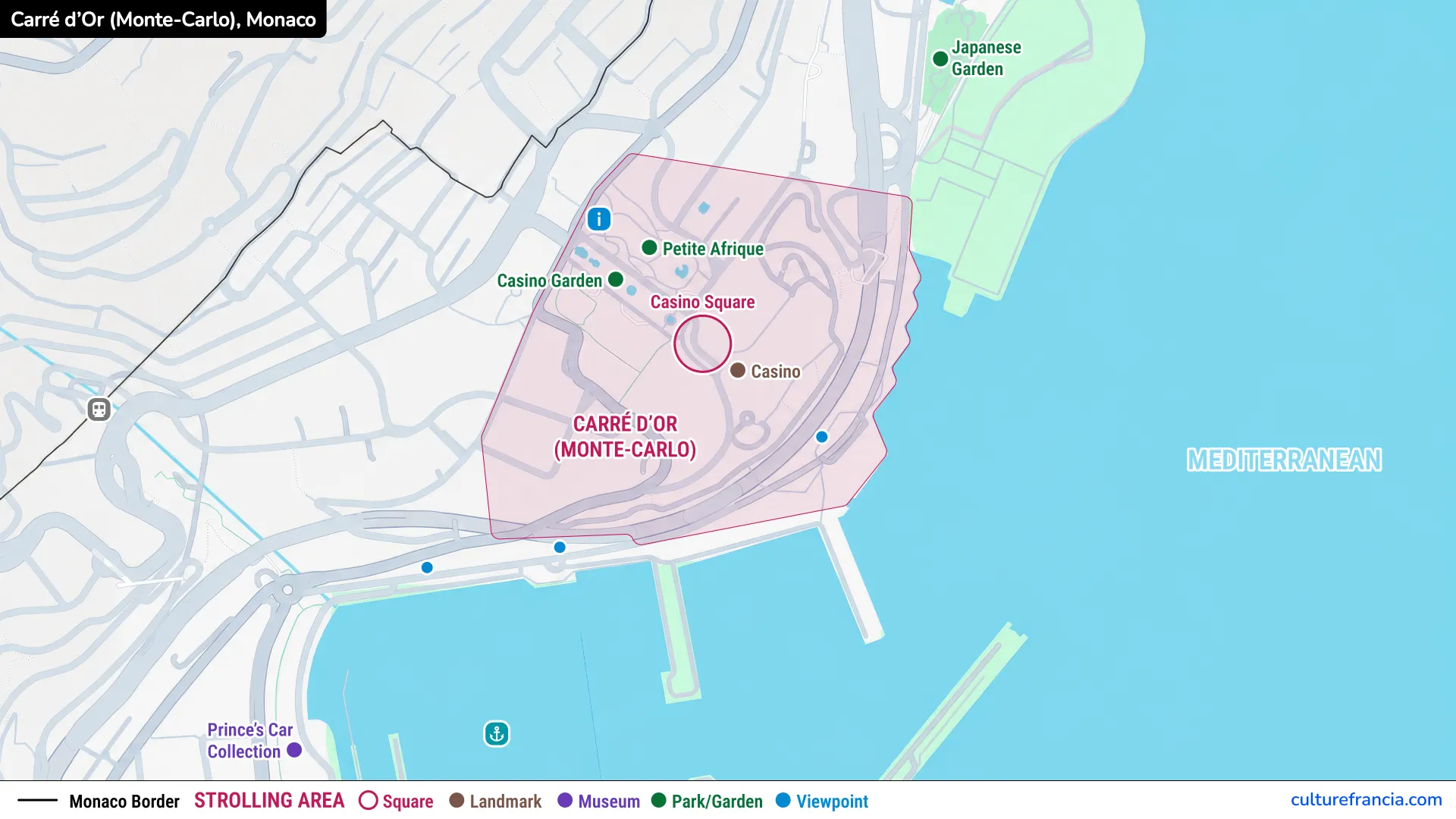
The image version gives you the quickest overview of the district. Use the Monte Carlo map image to see Casino Square and its surrounding landmarks in one glance.
It is ideal before your visit, especially for the Casino de Monte-Carlo, Hôtel de Paris, Opéra and nearby gardens. Keep it open while planning so you can group nearby sights.
PDF: Monte Carlo Tourist Map
Open the Monte Carlo Tourist Map PDF
The PDF is useful to save, print or consult offline. Open the Monte Carlo tourist map PDF for a simple overview of the district and its major attractions.
It works well beside a day plan, but Monaco’s slopes can make short map distances deceptive. Use it for orientation, then check the easiest pedestrian route between different levels.
Interactive: Monte Carlo Tourist Map

Click on the icon  in the top-right corner to view the map in full screen.
Show/Hide layers as needed.
After clicking on the image,
click on the icon  in the top-left corner to display the map legend.
Show/Hide layers as needed.
The interactive version lets you zoom into a street, garden or landmark. Use the interactive Monte Carlo map to explore the area around Casino Square in more detail.
Zoom out occasionally. Seeing Monte Carlo beside Port Hercule, La Condamine and Monaco-Ville prevents the common mistake of treating the casino district as the whole of Monaco.
Other Monaco Maps
Monaco Tourist Map
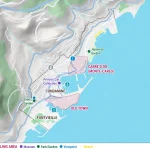
For the complete Principality, open our Monaco Tourist Map. It shows Monte Carlo together with Monaco City, Port Hercule, La Condamine, Fontvieille and Larvotto.
Use the overall map if your day includes several districts. It shows how the casino area connects with the harbor, the Rock and the eastern seafront.
Monaco City Tourist Map
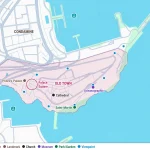
For the historic quarter on the Rock, use our Monaco City Tourist Map.
That map focuses on Monaco-Ville, the Prince’s Palace, Monaco Cathedral, Saint-Martin Gardens and the Oceanographic Museum. Choose it when your itinerary moves from Monte Carlo toward Monaco Old Town and Le Rocher.
Monte Carlo Map with Attractions and Landmarks
Casino de Monte-Carlo
The Casino de Monte-Carlo is the district’s defining landmark. Its historic complex, partly designed by Charles Garnier, faces the famous square at the center of Monte Carlo.
Find the casino first on the map, then use it as your main orientation point. Several of the district’s best-known buildings, gardens and luxury addresses sit within a very short walk.
Casino Square
Place du Casino is the heart of the area. If you only remember one geographic reference in Monte Carlo, make it Casino Square.
The casino, Hôtel de Paris and surrounding terraces give the square its unmistakable character. It is also a useful meeting point and a natural place from which to explore the nearby gardens, shopping streets and seaward side of the district.
Hôtel de Paris Monte-Carlo
The Hôtel de Paris stands directly on Casino Square and forms part of Monte Carlo’s classic image. Its location makes it one of the easiest landmarks to identify around the square.
Even if you are not staying there, the building helps anchor the route between the casino, Opéra and surrounding streets.
Opéra de Monte-Carlo
The Opéra de Monte-Carlo forms part of the casino complex and is closely associated with architect Charles Garnier. On the map, the Opéra belongs to the same compact sightseeing cluster as the casino and Hôtel de Paris.
That proximity is useful when planning. You can appreciate several of Monte Carlo’s most important architectural landmarks without crossing the entire district.
Japanese Garden
The Japanese Garden lies closer to the seafront, east of the Casino Square area. Use it as a quieter counterpoint to the grand architecture and luxury atmosphere of central Monte Carlo.
Its position also helps you understand the transition from the casino district toward Larvotto. If your route continues to the beach, the garden can fit naturally into the walk.
Monte Carlo District Map
Casino Square and Central Monte Carlo
Central Monte Carlo is organized around the casino area and Carré d’Or. This is the most concentrated zone for first-time visitors, with architecture, gardens, hotels and luxury shopping close together.
The district feels more spacious than Monaco-Ville, but the terrain still rises and falls. A map helps you choose streets that connect your sights without unnecessary backtracking.
Streets Around the Casino
The streets around Place du Casino mix historic façades, landscaped spaces and modern luxury developments. Plan this part of Monte Carlo as a walking area rather than a checklist of isolated attractions.
From the square, explore outward in short loops. This keeps the casino visible as a central reference and makes it easier to return before continuing toward Port Hercule or Larvotto.
Monte Carlo and the Larvotto Seafront
Larvotto lies east and below the central casino area. The Monte Carlo to Larvotto connection is useful if you want to combine architecture with the Mediterranean seafront.
On a flat map, the areas look almost adjacent. In reality, elevation matters, so use pedestrian links and lifts rather than assuming the shortest line is easiest.
How to Use the Monte Carlo Tourist Map
Walking Around Monte Carlo
Monte Carlo rewards walking because its main landmarks are close together. The key is to plan around Monaco’s vertical geography, not distance alone.
Start with Casino Square, explore the surrounding buildings and gardens, then decide whether to continue downhill toward Port Hercule or east toward Larvotto. We recommend avoiding unnecessary climbs by grouping sights before you set off.
Planning Your Visit Around Casino Square
For a short visit, make Casino Square your base point. From there, the Casino de Monte-Carlo, Hôtel de Paris and Opéra form an obvious first cluster.
Add nearby gardens and the Carré d’Or before moving to another district. If you plan to continue to the Rock, switch to the Monaco Tourist Map for the overall route and then use the Monaco City Tourist Map once you reach the historic quarter.
Monte Carlo is compact enough to explore without rushing, provided you read the slopes as carefully as the streets. The map helps you do exactly that.