




Menton Tourist Map: Image and PDF
Image: Menton Tourist Map
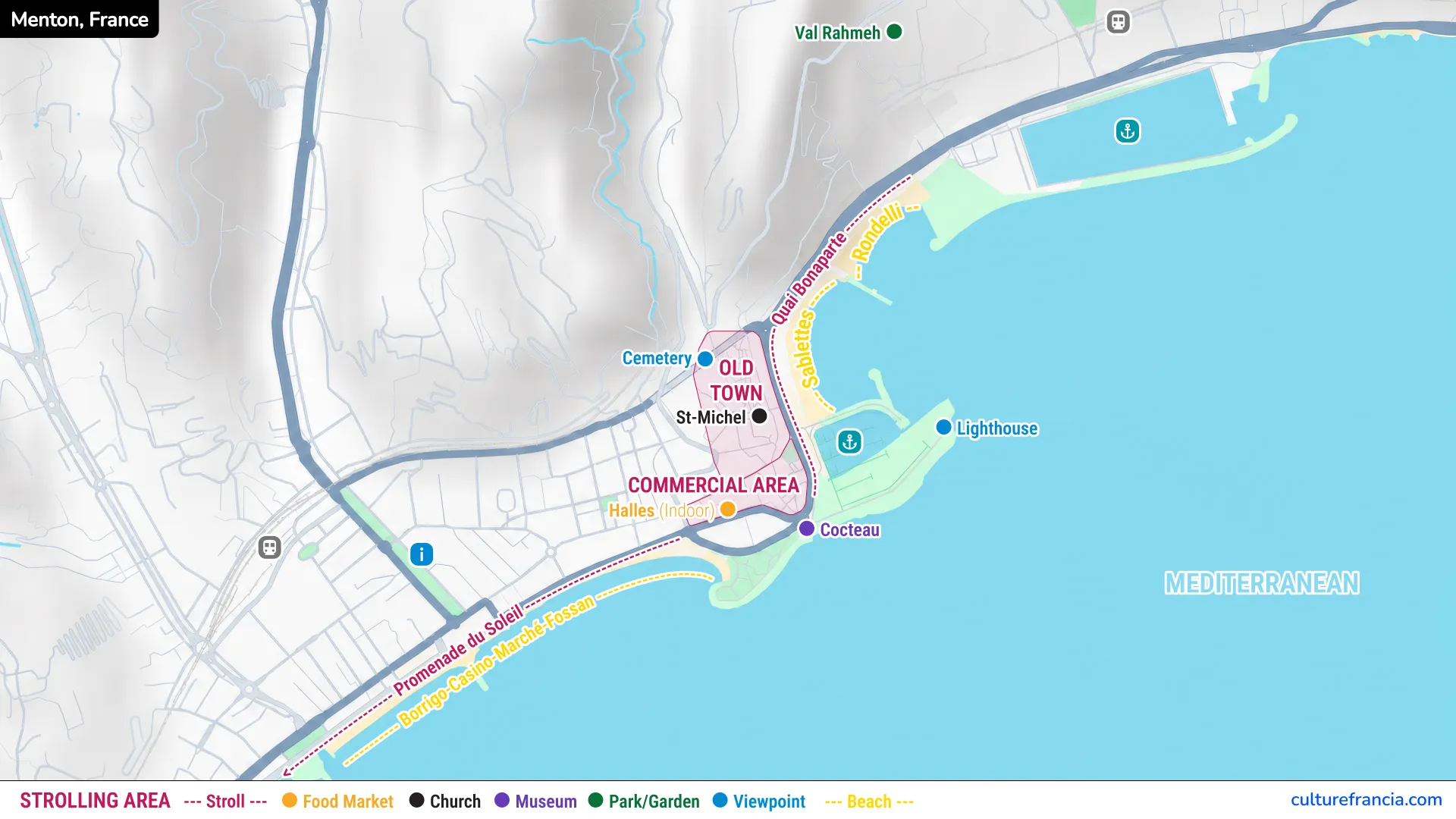
The image version is the quickest way to understand the shape of Menton before you start walking. It highlights the main sightseeing area, the Old Town, the commercial center and the seafront, while keeping the map simple enough to read on a phone.
You can immediately pick out Saint-Michel, the hilltop cemetery, the Halles indoor market, the Jean Cocteau area, Val Rahmeh, the lighthouse and the principal beach stretches. The color-coded symbols also separate churches, museums, gardens, viewpoints, markets and beaches, so there is no need to decode a cluttered street plan.
Open the full-size Menton tourist map image if you want a quick visual reference before your visit or while planning your walking route.
PDF: Menton Tourist Map
Open the Menton Tourist Map PDF
For travel planning, the PDF is the more practical version. Open the Menton Tourist Map PDF if you want a map that is easy to save, enlarge or print before leaving your accommodation.
It is particularly useful if you prefer to keep your sightseeing plan separate from online navigation. You can check the broad direction of your route, identify the main clusters of attractions, and see how the Old Town connects with the waterfront, beaches and eastern part of Menton.
The map is intentionally selective. It is not meant to show every street, shop or minor landmark. Its job is simpler: to help you understand where the places most visitors actually need are located.
Open the Menton Tourist Map PDF
Interactive Map of Menton

Click on the icon  in the top-right corner to view the map in full screen.
Show/Hide layers as needed.
After clicking on the image,
click on the icon  in the top-left corner to display the map legend.
Show/Hide layers as needed.
A static map is excellent for orientation, but there comes a point when you want to zoom in. The interactive map is designed for that moment. It lets you move from the big picture to individual streets, entrances and points of interest without losing the overall geography of the town.
Attractions and Landmarks on the Interactive Map
Use the interactive map when you need to locate a specific Menton attraction more precisely or work out the best way to reach it. This is especially handy in the Old Town, where narrow streets, stairways and steep lanes can make a simple-looking route rather less simple on the ground.
You can also use it to compare places that appear close together on the tourist map, check the surrounding streets, and decide whether to continue along the coast or climb into the historic center.
For us, the two formats work best together: use the tourist map to understand Menton, then use the interactive map for the final approach.
What You Can Find on the Menton Tourist Map
The map focuses on the part of Menton where sightseeing is most concentrated. That means you can quickly see the relationship between the old town on the hillside, the commercial streets below it and the Mediterranean waterfront.
Menton Old Town and Historic Landmarks
The pink Old Town area is the historic heart of Menton. Saint-Michel is the main landmark to use when orienting yourself in the old center, with the Basilica of Saint-Michel-Archange and its dramatic setting above the sea forming one of the town’s classic sights.
From here, lanes and stairways climb higher through the old houses toward the Vieux-Château cemetery. The climb is worth remembering when planning your day: Menton looks compact on a map, but this part of town is distinctly vertical.
The cemetery is also marked as a viewpoint. From this upper level, the town, surrounding slopes and Mediterranean coastline open out below. Then comes the pleasant part: wandering back down through the old streets rather than simply retracing a main road.
Markets, Museums and Gardens
Below the Old Town, the map marks the commercial area and the Halles indoor market, one of the easiest landmarks for finding the lively center of Menton. This is a useful point to aim for if you want to combine sightseeing with local food, shopping or a morning wander through the central streets.
Near the waterfront, the Cocteau marker identifies one of Menton’s best-known cultural associations. The Jean Cocteau museum area sits naturally on a walking route between the center, harbor and seafront.
Farther east, Val Rahmeh introduces a completely different side of the town. The botanical garden is worth treating as a destination rather than simply another stop in the Old Town circuit, particularly if gardens and Mediterranean or exotic planting are part of what brings you to Menton.
Beaches, Seafront and Viewpoints
Menton’s geography is wonderfully easy to read from the water. The map traces the seafront from the western beach strip and Promenade du Soleil toward the center, then continues around the bay toward Les Sablettes, Quai Bonaparte and Rondelli.
Les Sablettes is the most convenient beach to combine with an Old Town visit, sitting directly below the historic quarter. It is the sort of place where a sightseeing day can suddenly turn into an hour by the water, which is rarely a bad decision on the French Riviera.
The lighthouse is marked farther out by the harbor and makes another useful visual reference point. Meanwhile, the cemetery above the Old Town provides the elevated viewpoint. Between the two, Menton offers both versions of the Riviera panorama: looking up at the pastel old town from the sea, and looking back down at the Mediterranean from the hillside.
How to Explore Menton Using the Map
The easiest way to use a Menton attractions map is not to chase individual pins in random order. The town has a natural flow, and following it makes the visit feel like a stroll rather than a checklist.
A Walking Route Through Central Menton
We recommend beginning along the western seafront or Promenade du Soleil and gradually moving toward the central commercial area. From there, use the Halles market as your transition point between the modern center and historic Menton.
Continue toward the Jean Cocteau waterfront area, then turn inland and climb into the Old Town. Saint-Michel gives you an obvious target. If you have the energy, continue higher to the cemetery for the view before descending again toward Les Sablettes.
From the beach, you can follow the waterfront east along Quai Bonaparte toward Rondelli. Val Rahmeh can then be added as a separate garden stop if it fits your day. This route keeps the town’s major sights in a logical sequence and avoids unnecessary backtracking.
Getting Around Menton on Foot
Central Menton is well suited to walking, but the map can make the distances look flatter than they really are. The main practical difference is elevation: the waterfront is easy, while the Old Town involves slopes, stairways and steep lanes.
Comfortable shoes are a better idea than they may seem when you are standing beside the beach. In warm weather, it also makes sense to tackle the higher streets before lingering along the waterfront.
Do not treat the tourist map as a turn-by-turn navigation tool. Use it to keep your bearings and understand which part of town you are in. For exact street directions, entrances or the final few minutes to a garden or museum, switch to the interactive map.
Practical Tips for Using the Menton Map
Which Version of the Map Should You Use?
There is no single best format for every moment. The right Menton map depends on what you are doing at that point in your trip:
- Use the image for the fastest overview. It is best when you want to see the Old Town, beaches, waterfront and major attractions in one glance.
- Use the PDF for offline planning and easy reference. Save it to your phone or print it if you prefer having a fixed map while walking.
- Use the interactive map for precise navigation. Switch to it when you need an exact street, entrance, route or location.
- Use all three together for the easiest visit. Start with the image, keep the PDF as your sightseeing overview, and open the interactive map only when you need more detail.
Menton is compact enough that a good map quickly becomes intuitive. Once you understand the simple pattern of sea, waterfront, commercial center, Old Town and hills, you rarely feel lost for long. And that is exactly what a useful tourist map should do: not tell you where to look every second, but help the town fall naturally into place.