


PRESENTATION
The Massif Central, a Different Side of France
In the heart of France, far from the big cities and crowded beaches, lies a region unlike anywhere else. The Massif Central covers almost a sixth of the country. It’s a vast expanse of ancient mountains, high plateaus, forests, and deep valleys, where you can still travel for miles without coming across many people.
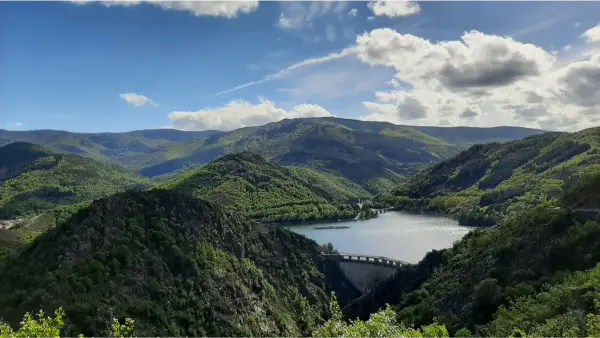
You won’t find peaks as towering as those in the Alps, but the landscape has plenty of character, with some mountains gently rounded and others rugged and jagged. Roads wind through the hills, pass through stone villages, and dip down into steep valleys. The scenery can change completely from one mountainside to the next. And sometimes, all you have to do is turn off a main road to feel like you’ve got the whole place to yourself.
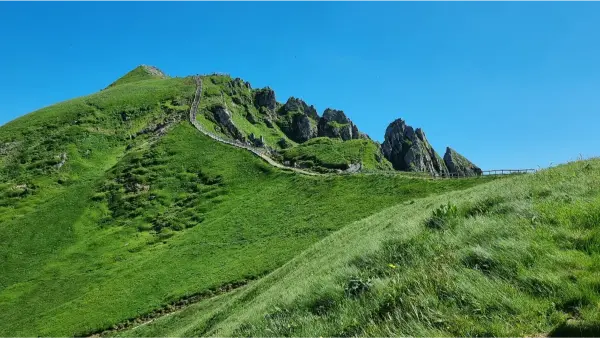
But the Massif Central is far from one uniform landscape. To the north, Auvergne is home to volcanoes and vast green meadows. Further south, Aubrac opens up into seemingly endless horizons, while the Cévennes reveal a wilder, more rugged landscape, with deep valleys and chestnut forests. In between, there’s a patchwork of scenery shaped by nature and centuries of human activity.
For a long time, this part of France remained off the main transport routes, helping it preserve its strong rural identity. Towns are relatively few and far between, villages can be tiny, and distances are often deceptive. Two places might look close together on a map, but in reality, they can be separated by miles of winding mountain roads.
The climate adds even more variety. Winters can be harsh at higher elevations, where snow sometimes blankets the landscape for weeks on end. In summer, the days are often sunny, but evenings stay cool up in the mountains. Further south, the Mediterranean influence brings warmer, drier conditions.
From the Volcanoes of Auvergne to the Wild Valleys of the Cévennes
To understand the landscapes of the Massif Central, you have to go a very long way back in time. Long before the first villages appeared, movements deep within the Earth pushed up, fractured, and reshaped these mountains. Then volcanoes came onto the scene, sending rivers of lava flowing across the land and building up layers of rock. Erosion continued the process, carving out valleys and gradually smoothing the mountains.
In Auvergne, the volcanoes are the real stars of the show. The Chaîne des Puys is a string of dozens of volcanic cones and craters, many of them remarkably symmetrical. Rising to 1,465 meters, the Puy de Dôme towers over this volcanic landscape. Further south, the Puy de Sancy reaches 1,885 meters, making it the highest point in the Massif Central. With its steep ridges and deep valleys, the scenery almost feels like the Alps.
The Cantal Mountains tell another story of the region’s volcanic past. Here, a massive volcano was gradually worn away by erosion, leaving behind sharp peaks, long ridgelines, and lush green valleys. On the slopes, forests alternate with wide open pastures where herds of cows graze.
Head up onto the Aubrac plateau, and the atmosphere changes completely. The hills become gentler, trees grow scarcer, and grasslands stretch as far as the eye can see. Huge boulders are scattered across the pastures, while small lakes fill hollows left behind by ancient glaciers. When mist rolls across the plateau, the whole place takes on an almost otherworldly feel.
Further south, the Cévennes offer a much more dramatic landscape. Chestnut forests cover the mountainsides, while rivers cut deep valleys between steep slopes. Not far away, vast limestone plateaus are split by spectacular gorges, especially the Gorges du Tarn, where towering cliffs rise above a turquoise river.
This incredible range of landscapes also supports a rich variety of wildlife and plants. Birds of prey, deer, and countless smaller animals find shelter in the forests and mountains. In spring, the high mountain meadows burst into bloom with wildflowers. Come autumn, the beech and chestnut forests turn beautiful shades of gold.
A Land of Character, Villages, and Traditions
In this mountainous part of France, people have always had to adapt to a sometimes harsh natural environment. For centuries, farming and raising livestock shaped everyday life. Locals cleared forests, built stone walls to mark out their fields, and carved terraces into the steepest hillsides. The result is a landscape shaped patiently over generations, where every stone seems to have a story to tell.
You can see that history in the architecture too. In some places, houses are built from dark volcanic rock, while elsewhere they’re made from grey granite or warm, golden limestone. Roofs are sometimes covered with heavy stone slabs designed to withstand harsh winters. In the old villages, cobbled lanes, arched passageways, fortified towers, and medieval houses form beautifully preserved historic settings.
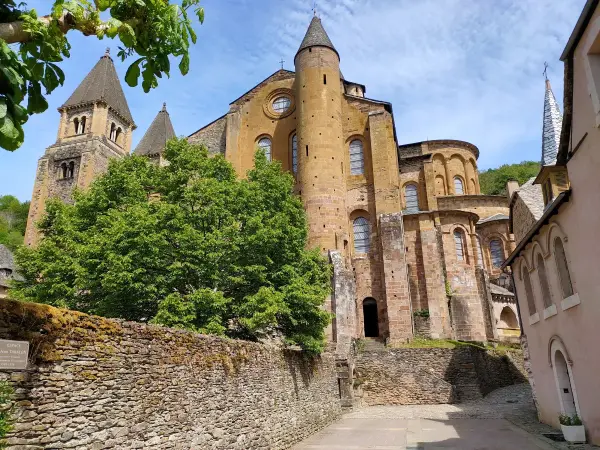
The Massif Central also has a rich religious history. From the Middle Ages onward, powerful monasteries were established in its valleys and mountains. Some became major spiritual centers, welcoming travelers from all over Europe. The pilgrimage routes leading to Santiago de Compostela, the famous pilgrimage destination in northwestern Spain, still run through the region today. Conques, with its magnificent abbey and historic houses, is one of the most moving reminders of this heritage.
And when it comes to food, there’s no shortage of local traditions. Livestock farming has given rise to an incredible variety of cheeses, including Cantal, Saint-Nectaire, and Roquefort. One of the most iconic local dishes is aligot, a rich mix of mashed potatoes and melted cheese that’s stretched into long, gooey ribbons. In the mountains, chestnuts, lentils, and farm-fresh ingredients also play an important role in traditional cooking.
But the Massif Central isn’t just about historic buildings and hearty food. Knife making, lacework, and tapestry weaving are all examples of traditional skills passed down through generations. Village festivals also help keep local customs alive. Up in the high pastures, the return of the herds for the warmer months is still a special occasion, complete with the sound of cowbells and livestock traditions that sometimes go back centuries.
OVERVIEW
Map
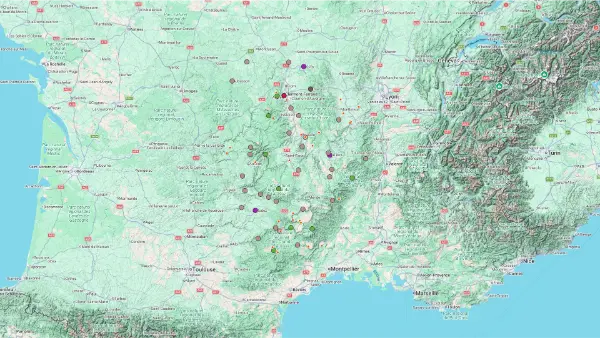
Interactive Map
Interactive Map
Click on the icon  in the top-left corner to display the map legend.
Show/Hide layers as needed.
Click on the arrow icons (v) to display the sublayers.
Top Picks