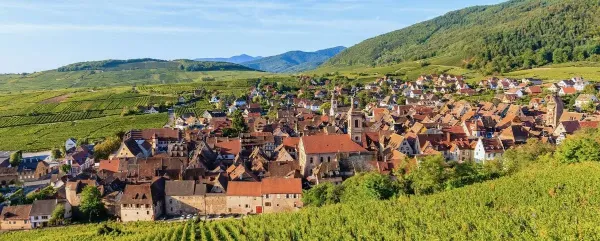



INTERACTIVE MAP
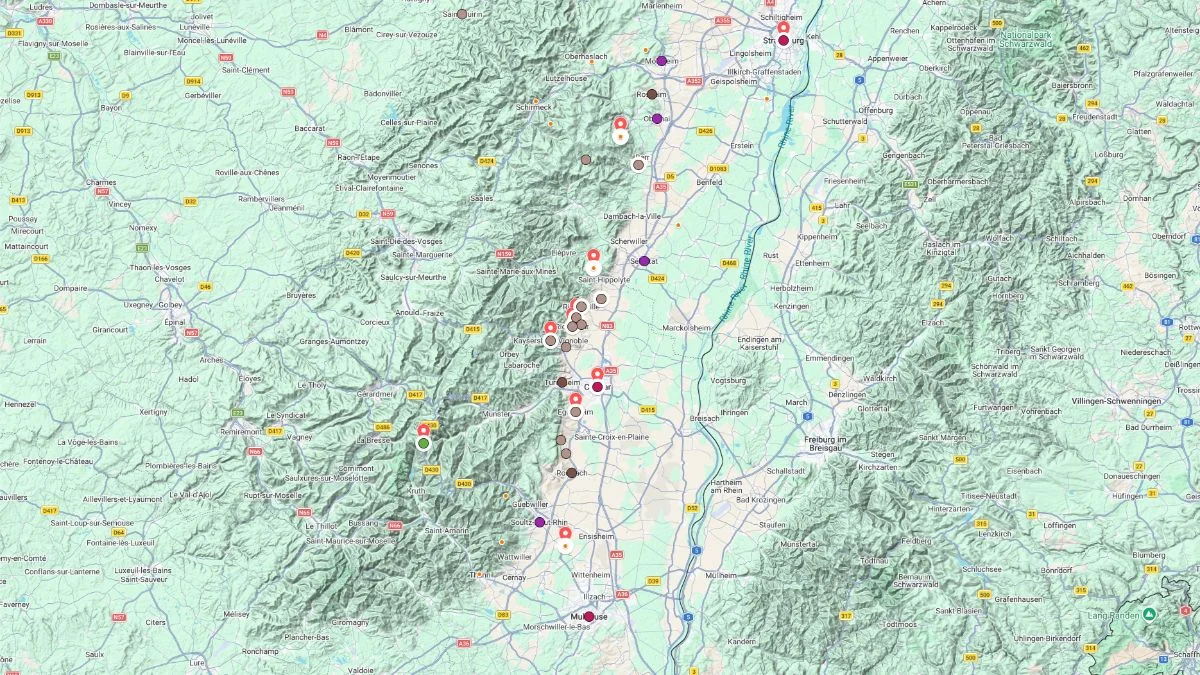
Click on the icon  in the top-right corner to view the map in full screen.
Show/Hide layers as needed.
After clicking on the image,
click on the icon  in the top-left corner to display the map legend.
Show/Hide layers as needed.
CITIES
Overview Table
| Name | Population | Top Picks | Exp. Picks |
|---|---|---|---|
| Strasbourg | 300 000 | ✅ | ☑️ |
| Colmar | 70 000 | ✅ | ☑️ |
| Mulhouse | 100 000 |
Strasbourg

In Our Top Picks ✅
Population 300 000
Strasbourg feels like a city with two different rhythms, one of a major European hub full of activity, and another of an old historic center where the water, stone buildings and half timbered houses create a more intimate atmosphere. You’re walking through an important city, yet the center remains easy to understand, pleasant, and almost naturally made for exploring on foot.
The cathedral immediately makes its presence felt. Its richly decorated façade, filled with vertical lines, sculptures and intricate details, catches your eye even before you reach the square. Inside, the astronomical clock also reflects the city’s long standing appreciation for knowledge, engineering and grand historical settings.
Around it, the old streets gradually lead you toward Petite France. Here, the Ill River splits into several branches, giving the district its distinctive atmosphere. Old houses are reflected in the water, bridges connect the riverbanks, and the locks seem to slow down the pace. You walk past carved façades, steep roofs and narrower passages, in surroundings that remain lively despite their almost theatrical charm.
Yet Strasbourg is not limited to this historic image. Leaving the center, you can head into the Neustadt, the district built during the German period. The atmosphere changes, the streets become wider, the buildings more monumental, with architecture inspired by several European styles. This transition between two worlds perfectly reflects the city’s identity, shaped for centuries by both French and German influences.
Further on, Strasbourg turns toward the Rhine and toward Europe. European institutions, the tram network, cycling paths and direct connections with Germany give the city an open, youthful and dynamic feel. You get the sense of a historic destination that keeps evolving without losing what makes it so beautiful.
Colmar

In Our Top Picks ✅
Population 70 000
Colmar is best discovered on foot, with your eyes constantly drawn upward to the façades. You move through a dense old town filled with decoration, where half timbered houses, tightly packed roofs, old windows and carved details make it feel as though the city has been spared many of the disruptions of modern times.
The beauty of the city is easy to appreciate. Bright colors cover the walls, flower filled balconies overlook narrow lanes, hidden courtyards appear unexpectedly, and large historic buildings and church towers rise above the rooftops. Together, they create a continuous atmosphere that feels almost theatrical.
The most famous area is the network of small canals. Water flows between colorful houses, beneath bridges and along the foot of the façades. In spring and autumn, the district has a softer charm, while in summer it becomes noticeably busier. You can also spot the flat bottomed boats that were once used by farmers from the surrounding countryside.
Colmar also has a strong artistic side. The Unterlinden Museum is one of the highlights of any visit. Its collection combines historic buildings with modern spaces, old masters with modern art, and several major works, giving the city a remarkable cultural depth for a place of its size.
Mulhouse

Population 100 000
Mulhouse shows you a different side of Alsace, less like a postcard and more industrial, inventive and urban. Its history is closely tied to the textile industry, large factories and the entrepreneurial families who transformed the city during the nineteenth century.
In the center, you can still find traces of an older past, painted façades, historic buildings, a former chapel and streets that hint at the city’s commercial heritage. The Nouveau Quartier then reflects the era of powerful industrialists, with its arcades, colonnades and more orderly layout.
Mulhouse is especially known for its major museums. The Cité de l’Automobile houses a spectacular collection of vintage cars, while the Cité du Train presents locomotives, railway carriages and immersive displays spread across a vast site. These museums highlight the city’s strong connection to industry and innovation, giving Mulhouse a character that stands apart from the rest of Alsace.
TOWNS
Overview Table
| Name | Top Picks | Exp. Picks |
|---|---|---|
| Wissembourg | ☑️ | |
| Saverne | ||
| Molsheim | ||
| Obernai | ||
| Sélestat | ||
| Soultz-Haut-Rhin |
Wissembourg
In Our Expanded Picks ☑️
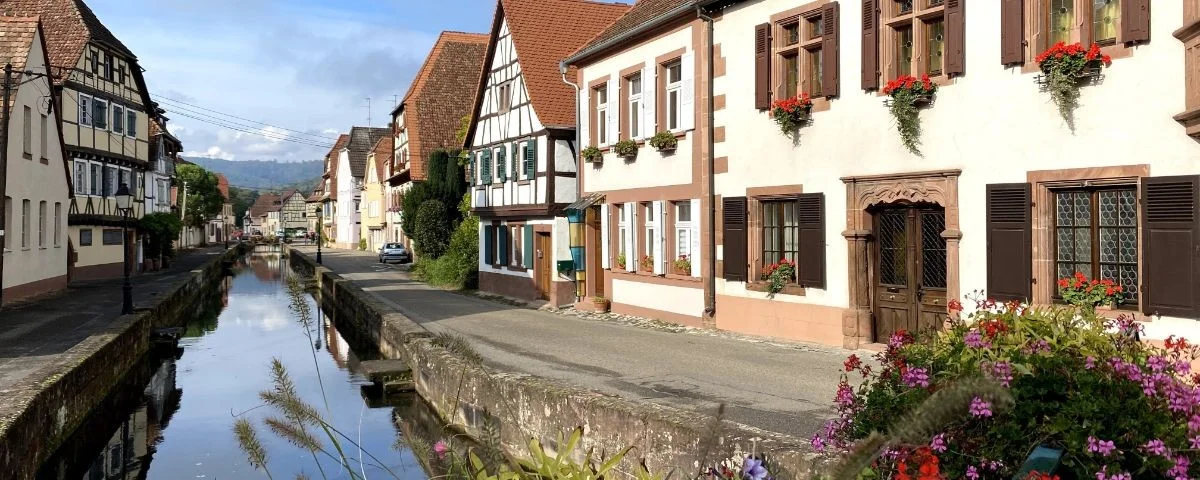
Wissembourg has the atmosphere of a quiet old town set close to the German border. Here you’ll find a vast Gothic church, one of the most impressive religious buildings in Alsace, featuring an older tower, medieval stained glass windows and a monumental painting of Saint Christopher.
Around it, the streets preserve beautiful old houses, buildings linked to the former religious authorities and the Maison du Sel, easily recognized by its large roof pierced with distinctive wavy openings. At the foot of the building, a branch of the river follows a particularly charming walk, almost intimate in feel, with water, historic façades and peaceful corners all around.
Saverne
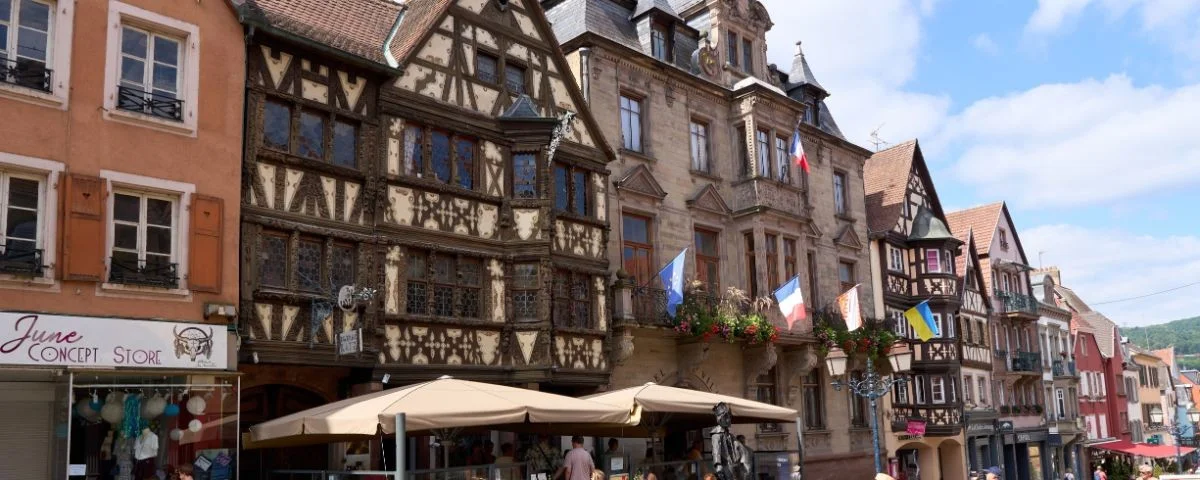
Saverne is surprisingly grand. The town lies between the Alsatian plain and the wooded mountains, which explains its historical role as a gateway to the interior. Its center retains a strong historic character, especially around the immense Château des Rohan, which was associated with centuries of religious power.
You can also admire a richly decorated German Renaissance house, with carved woodwork, floral motifs and playful details. A little farther away, the wooded hills offer beautiful viewpoints over the town and the surrounding plain, with Saverne stretching out below.
Molsheim
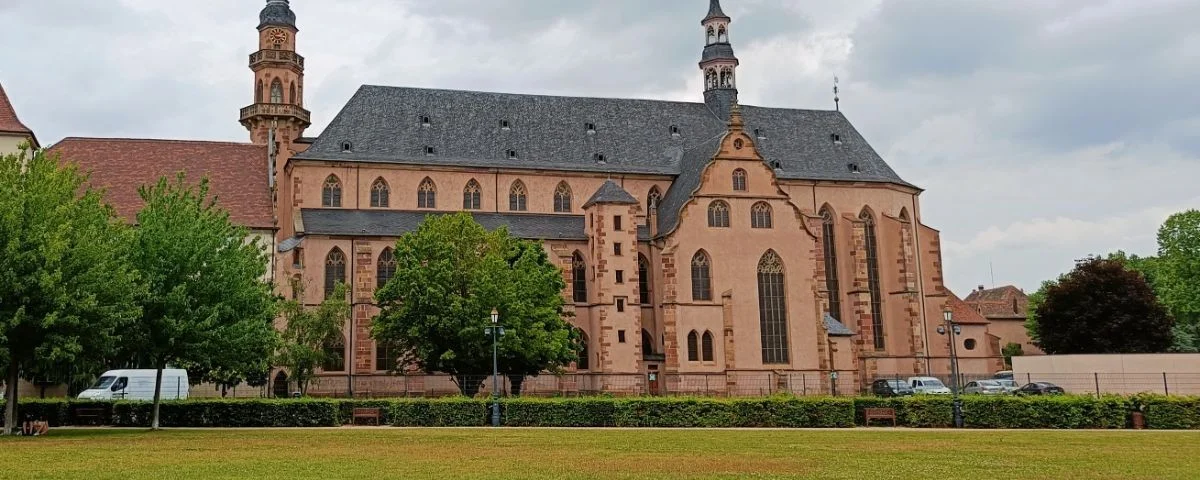
Molsheim combines religious heritage, artisanal traditions and automotive history. The large Jesuit church stands out with its impressive proportions, onion shaped tower, harmonious nave and chapels decorated with stucco and gilded details. The Forge Gate is a reminder of the days when the town was protected by defensive walls.
The museum housed in the former Carthusian monastery allows you to explore a historic religious complex, complete with cloister and monks’ cells. The section dedicated to Bugatti highlights Molsheim’s connection to one of the most prestigious engineering adventures in automotive history, with rare documents, family objects and legendary cars.
Obernai

Obernai offers one of the clearest images of traditional Alsace, with streets lined by half timbered houses, colorful façades and reminders of its fortified past. A walk through the center takes you past the main square, the old grain market, historic streets and several hidden courtyards where wooden galleries, wells and medieval buildings appear unexpectedly.
Above all, Obernai invites you to slow down and notice the details, exposed beams, gables, window frames and inner courtyards. Some streets seem to gather everything that makes the town so appealing, creating the feeling of a compact, carefully preserved and lively place.
Sélestat

Sélestat has a strong identity. Its old center contains numerous protected monuments, historic houses, traces of former fortifications and several buildings connected to the city’s religious and intellectual past.
The town is especially known for the Humanist Library, housed in a nineteenth century market hall that has been transformed with a contemporary design. Here, you discover the importance of Sélestat during the Renaissance, when its school educated part of Europe’s scholarly elite.
Soultz-Haut-Rhin
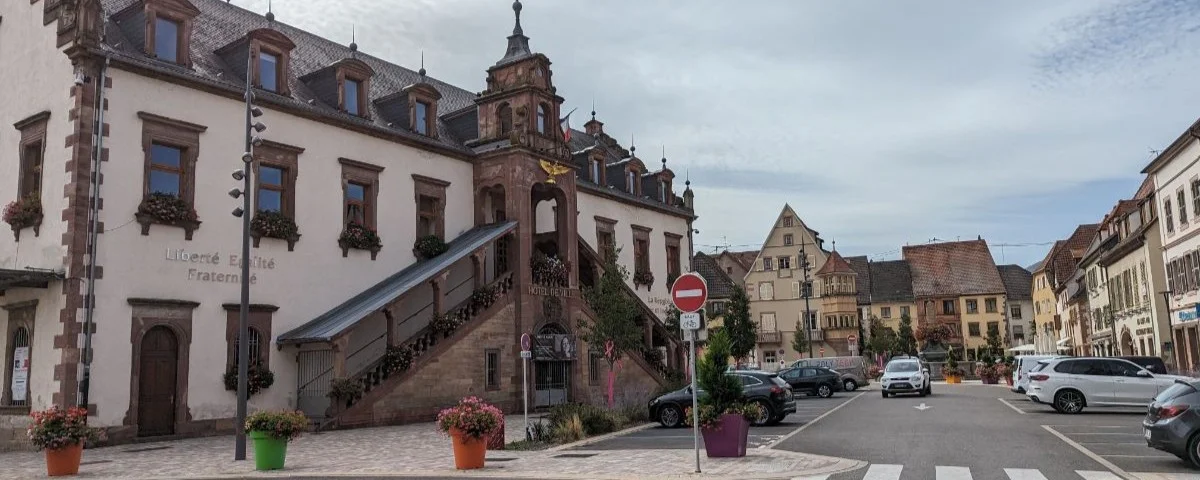
Soultz Haut Rhin is best appreciated through its discreet heritage, centered around historic buildings that have been turned into places of memory. The Château du Bucheneck, once the residence of the local representative of the Bishop of Strasbourg, now houses a varied museum featuring archaeology, portraits of noble families, religious objects, local traditions and historical documents.
The town is also home to a toy museum located in a former commandery of the Order of Malta. Inside, you’ll find dolls, teddy bears, figurines, model trains, miniature displays, lead soldiers and antique games. Altogether, Soultz offers a more intimate side of Alsace, less spectacular than some other towns, but full of charm and small discoveries.
SMALL TOWNS (Village Feel)
Overview Table
| Name | Top Picks | Exp. Picks |
|---|---|---|
| Seebach | ||
| Betschdorf | ||
| Bouxwiller | ||
| Rosheim | ||
| Turckheim | ||
| Rouffach |
Seebach
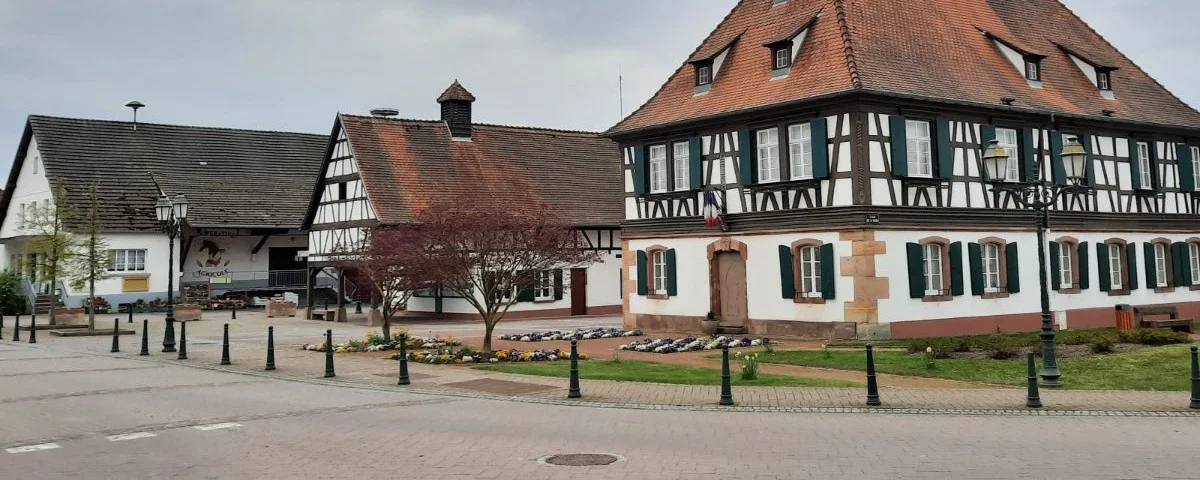
Seebach shows you a very well preserved rural Alsace, with large white farmhouses structured by visible black beams. The streets are long, quiet and almost regular, giving the impression of a village that has stayed very close to its old appearance.
You can notice the rectangular courtyards, simple façades, details carved into the wood and traces left by families from the past. The church, with its thirteenth century defensive tower, and the eighteenth century town hall give the village a strong historical presence, without anything feeling artificial.
Betschdorf
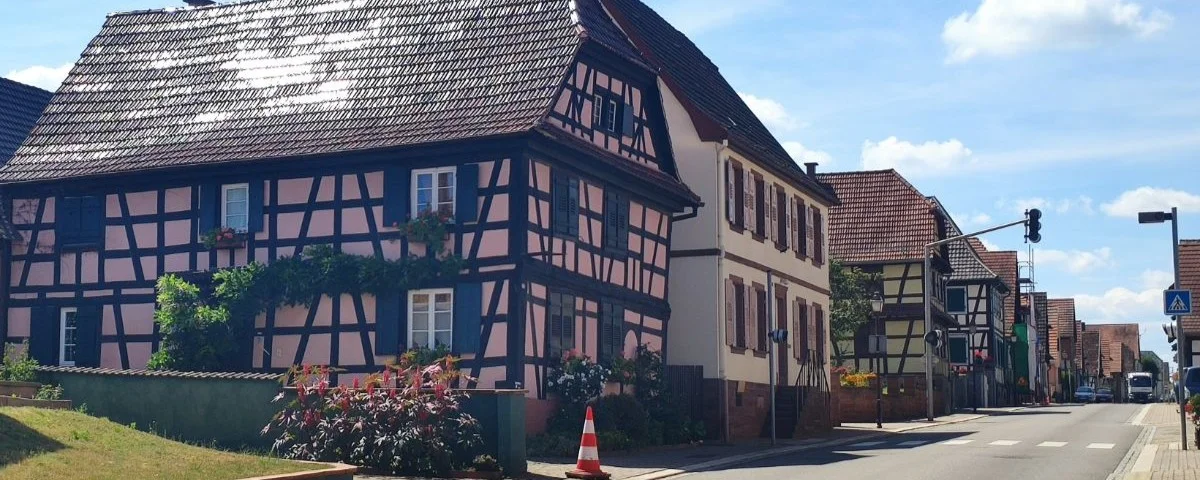
Betschdorf is a flower filled, harmonious village, marked by traditional architecture and by a very recognizable craft, grey and blue pottery. This identity comes from a technique brought here in the eighteenth century by artisans.
Here, you discover a more understated Alsace, connected to earth, kilns and everyday objects. The local stoneware, decorated and then salt glazed, produces strong, shiny pieces, often adorned with cobalt blue. The church also preserves rare and highly expressive old frescoes.
Bouxwiller
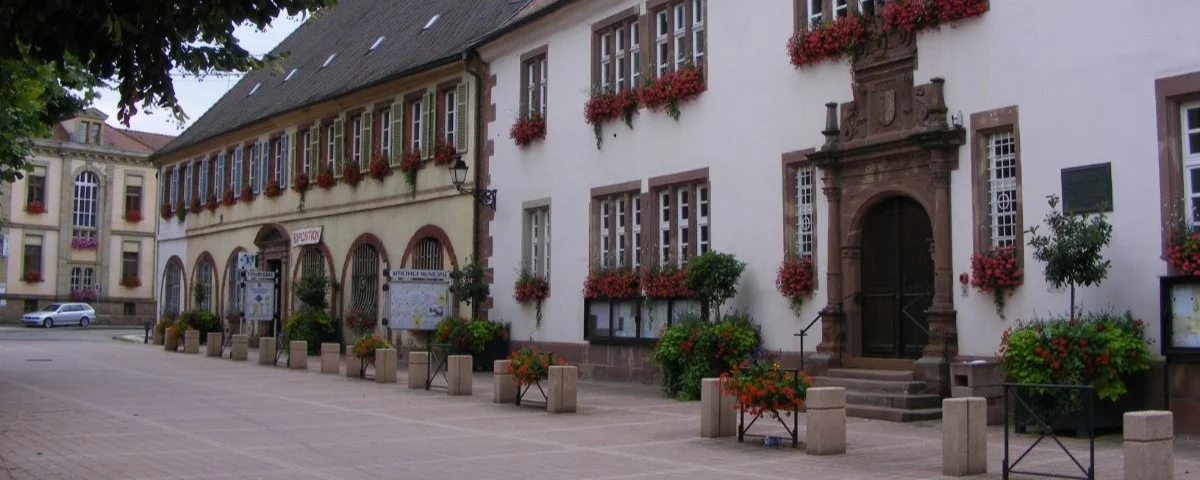
Bouxwiller still carries the memory of a small aristocratic capital. Even though the former grand château has disappeared, the town keeps beautiful bourgeois houses with exposed beams, carved stonework and richly detailed façades.
You walk through a dense setting of small squares, old streets and sometimes unexpected details. The Grain Market Square, the interlocking houses, the ornaments along rue de l’Église and the views of flower covered façades give Bouxwiller a refined charm that never feels frozen in time.
Rosheim
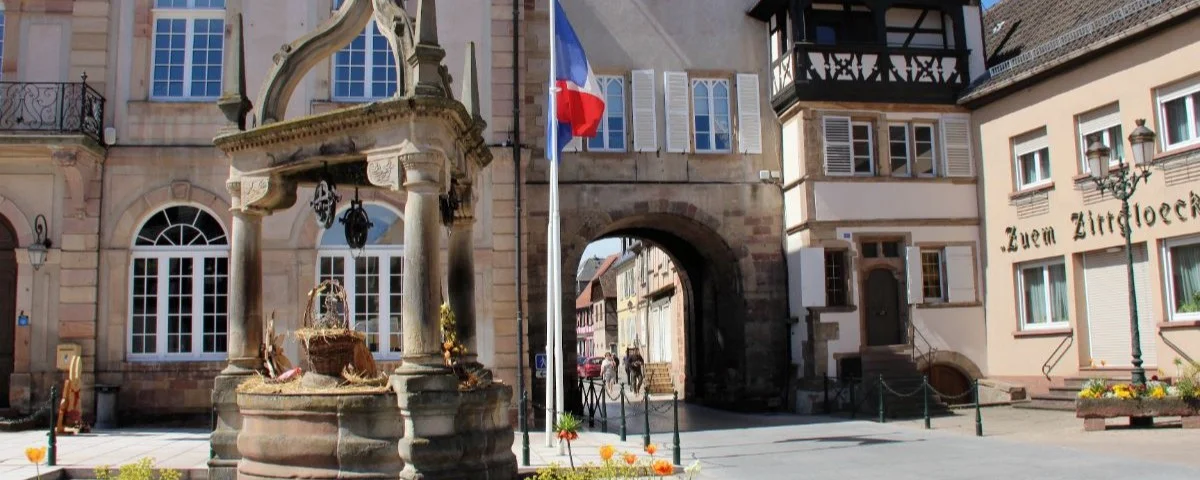
Rosheim stands out for its old world atmosphere and for one of the most beautiful Romanesque churches in Alsace, built from yellow stone that turns golden in the sun. Following the main street, you pass several old defensive gates, traces of the town’s two former walls.
On the façades, look for the carved signs of old trades, bread, pretzels, bunches of grapes or winegrowers’ tools. The Romanesque house, massive and square, offers a rare glimpse of stone housing in the Middle Ages.
Turckheim

Turckheim is a small old town surrounded by vineyards, with a compact center where colorful houses still carry a real sense of history. You enter through old gates, then discover quiet streets, carefully kept façades and a sheltered atmosphere.
The town grew wealthy in the fifteenth century thanks to the wine trade, and this history is still visible in its setting. The close packed roofs, defensive walls, house details and nearby hillsides give Turckheim a solid, elegant and deeply Alsatian character.
Rouffach
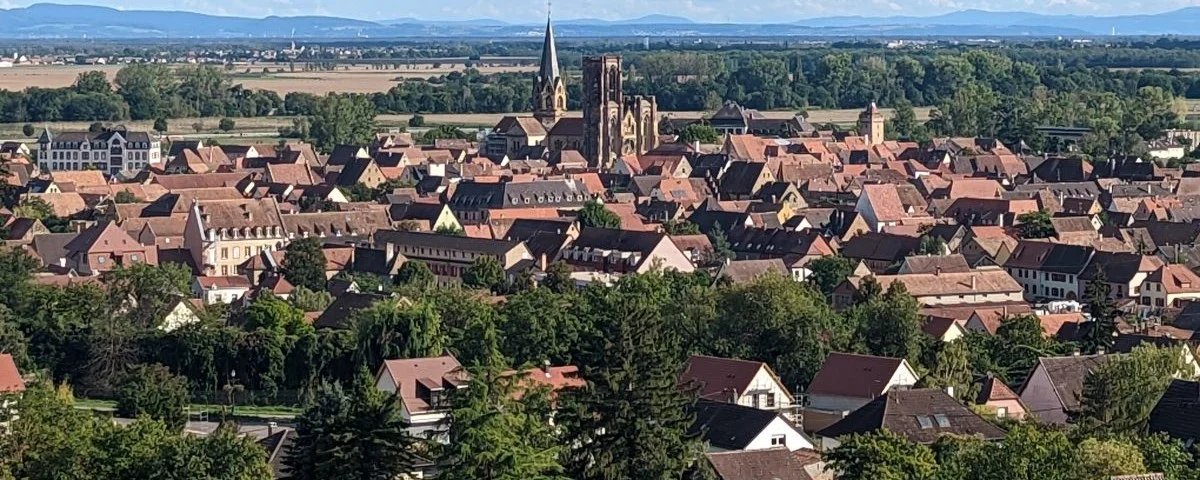
Rouffach is an old town, less visited than many others, where the feeling of stepping back in time remains strong. Unlike many nearby villages, it is not dominated by half timbered houses, but by Renaissance architecture, with stone volumes, noble façades and a real sense of unity.
You can walk along the old defensive walls, through the historic quarters and around Place de la République. The Church of Notre Dame of the Assumption, built in yellow and pink sandstone, shows the transition between two major medieval religious styles. Look up too, storks are part of the scenery.