


YOUTUBE VIDEO (12:34)
INTERACTIVE MAP
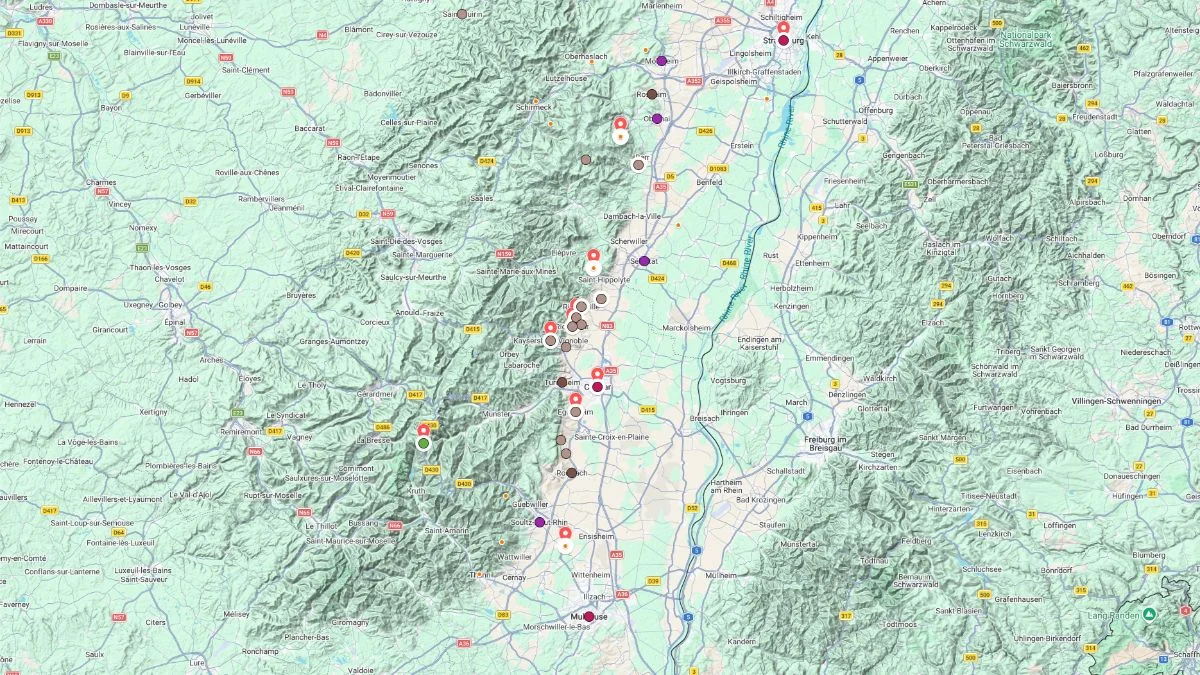
Click on the icon  in the top-right corner to view the map in full screen.
Show/Hide layers as needed.
After clicking on the image,
click on the icon  in the top-left corner to display the map legend.
Show/Hide layers as needed.
ALL
Overview Table
| Name | Type |
|---|---|
| Strasbourg | City |
| Sainte-Odile | Sanctuary |
| Haut-Kœnigsbourg | Castle |
| Hunawihr | Village |
| Riquewihr | Village |
| Kaysersberg | Village |
| Colmar | City |
| Eguisheim | Village |
| Vosges | Mountains |
| Écomusée d'Alsace | Open-Air Museum |
Strasbourg

Type City
Population 300 000
Strasbourg feels like a city with two different rhythms, one of a major European hub full of activity, and another of an old historic center where the water, stone buildings and half timbered houses create a more intimate atmosphere. You’re walking through an important city, yet the center remains easy to understand, pleasant, and almost naturally made for exploring on foot.
The cathedral immediately makes its presence felt. Its richly decorated façade, filled with vertical lines, sculptures and intricate details, catches your eye even before you reach the square. Inside, the astronomical clock also reflects the city’s long standing appreciation for knowledge, engineering and grand historical settings.
Around it, the old streets gradually lead you toward Petite France. Here, the Ill River splits into several branches, giving the district its distinctive atmosphere. Old houses are reflected in the water, bridges connect the riverbanks, and the locks seem to slow down the pace. You walk past carved façades, steep roofs and narrower passages, in surroundings that remain lively despite their almost theatrical charm.
Yet Strasbourg is not limited to this historic image. Leaving the center, you can head into the Neustadt, the district built during the German period. The atmosphere changes, the streets become wider, the buildings more monumental, with architecture inspired by several European styles. This transition between two worlds perfectly reflects the city’s identity, shaped for centuries by both French and German influences.
Further on, Strasbourg turns toward the Rhine and toward Europe. European institutions, the tram network, cycling paths and direct connections with Germany give the city an open, youthful and dynamic feel. You get the sense of a historic destination that keeps evolving without losing what makes it so beautiful.
Sainte-Odile

Type Sanctuary
Price Free
Full Names
Sanctuaire du Mont Sainte-Odile
Abbaye de Hohenbourg
The Mont Sainte Odile sanctuary stands on a summit 764m above sea level, overlooking the Alsace plain and the first ridges of the Vosges Mountains. It is one of the region’s most iconic and spiritual places.
The site takes its name from Saint Odile. In the seventh century, she founded a convent for women here and became its abbess. Known for her generosity, she was canonised after her death in 720 and remains the patron saint of Alsace to this day.
You reach the sanctuary through a large courtyard shaded by old lime trees before making your way to the church. Inside, the atmosphere is simple and peaceful, with columns, wood panelling, carved choir stalls and a Stations of the Cross made in marquetry.
The vast terrace is one of the highlights of the sanctuary. The space suddenly opens up, the air seems broader, and your gaze drops over the wooded slopes before stretching out across the plain. This terrace gives the site the feel of a true belvedere. You’re no longer just in a religious setting, you’re standing before a sweeping landscape of mountains, forests and distant horizons.
Haut-Kœnigsbourg

Type Castle
Price €12
Full Name
Château du Haut-Kœnigsbourg
The Haut-Koenigsbourg Castle overlooks Alsace from a rocky spur nearly 800 metres above sea level. You can spot it from far away, clinging to the mountainside like a massive silhouette above the vineyards, forests and villages. Its elevated position gives it a truly dramatic presence in the landscape.
As you make your way up, you arrive at the most impressive castle in the Vosges Mountains. Its restoration has given it back a powerful, almost theatrical appearance, with imposing walls, towers and the atmosphere of a medieval stronghold.
Inside, the visit takes you through rooms furnished and decorated in a reconstructed medieval style. You’ll see carved chests, finely crafted woodwork, a chapel and collections of historic weapons.
The route then leads to the great bastions. From these defensive terraces, the views become immense. On a clear day, they stretch across the mountains, the villages and sometimes as far as the most distant horizons.
Hunawihr

Type Village
Hunawihr is a peaceful winegrowing village set among houses, fields and rows of vines. The atmosphere feels gentler than in the more crowded places, with a clear balance between historic homes, agricultural life and vine covered slopes.
To the north, a small wooded hill overlooks the Rosacker area, famous for its vineyards. The winegrowers’ houses, quiet streets and the Church of Sainte Hune, surrounded by its old enclosure, give the village a discreet presence, almost as if it were suspended in time.
Riquewihr

Type Village
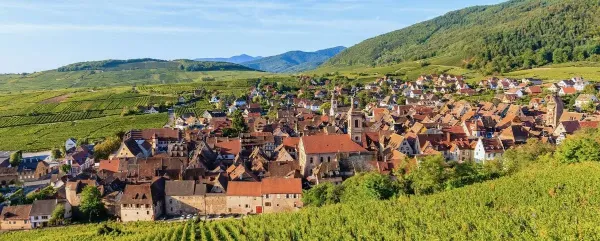
Riquewihr offers perhaps the most striking image of the traditional Alsatian village: winegrowers’ houses, timber framed façades, grander buildings, cobbled streets and walls that still surround the old centre. Walking through it feels like stepping into a remarkably preserved setting, almost theatrical, especially early in the morning or later in the evening.
Its charm comes as much from the overall atmosphere as from the small details: gateways, courtyards, signs, flower filled windows and tightly packed houses within the old fortified area. All around, the vineyards form a continuous backdrop, crossed by a walking trail that passes through several renowned winegrowing sites.
Kaysersberg

Type Village
Kaysersberg offers a wonderfully complete picture of old Alsace, with flower filled streets, tightly packed houses, beautifully detailed façades and vineyards climbing the surrounding slopes. You quickly get the feeling that the village has a deep historical character without losing its lively atmosphere.
The fortified bridge, the old stonework and the vine covered hills give the village a striking sense of relief. If you wander a little beyond the centre, you’ll come across open viewpoints overlooking the slopes, rooftops and neat rows of vines.
Colmar

Type City
Population 70 000
Colmar is best discovered on foot, with your eyes constantly drawn upward to the façades. You move through a dense old town filled with decoration, where half timbered houses, tightly packed roofs, old windows and carved details make it feel as though the city has been spared many of the disruptions of modern times.
The beauty of the city is easy to appreciate. Bright colors cover the walls, flower filled balconies overlook narrow lanes, hidden courtyards appear unexpectedly, and large historic buildings and church towers rise above the rooftops. Together, they create a continuous atmosphere that feels almost theatrical.
The most famous area is the network of small canals. Water flows between colorful houses, beneath bridges and along the foot of the façades. In spring and autumn, the district has a softer charm, while in summer it becomes noticeably busier. You can also spot the flat bottomed boats that were once used by farmers from the surrounding countryside.
Colmar also has a strong artistic side. The Unterlinden Museum is one of the highlights of any visit. Its collection combines historic buildings with modern spaces, old masters with modern art, and several major works, giving the city a remarkable cultural depth for a place of its size.
Eguisheim

Type Village
Eguisheim is a very compact village, built like a spiral around its historic centre. You don’t follow long straight streets here. Instead, you turn corners, circle around and make your way between colourful façades, timber framed houses and narrow passages that give the village its unmistakable character.
Much of its appeal comes from this sense of winding around the centre. With every turn, the view changes slightly: a pink or yellow façade, a flower filled balcony, an old sign or a tighter corner opening onto another charming street.
At the heart of the village, the Counts’ Castle overlooks a small square with a fountain. The chapel dedicated to Pope Leo IX adds a more unusual touch, with its vivid colours and an interior covered in paintings.
Vosges

Type Mountains
Full Name
Massif des Vosges
The Vosges provide the most striking backdrop to Alsace, a chain of mountains, forests and valleys that closes off the western horizon. From the villages along the Wine Route, these heights appear as a vast green wall, with fir covered slopes and ruined castles perched above the plain.
As you climb higher, the scenery becomes more expansive. Valleys cut deep between the hills before opening onto mountain lakes, high pastures and wind swept ridges. The Route des Crêtes follows this high line for nearly 80 kilometres, offering sweeping views over forests, rounded summits and wide open landscapes.
You can explore these mountains by car, but their true character reveals itself on foot. Marked trails lead you from villages into the forests, and from the forests up to the higher ground. Some places also preserve the memory of the WW1, as these peaceful landscapes were once deeply shaped by the fighting.
Écomusée d'Alsace

Type Open-Air Museum
Price €16.50
Full Name
Écomusée d’Alsace
The Alsace Ecomuseum was designed as a real reconstructed Alsatian village, and this open air museum gives you a unique glimpse into rural life in the past. It brings together a whole set of traditional half timbered houses, carefully taken apart and rebuilt on site, so that an architectural heritage at risk of disappearing could be preserved. Each building reflects a way of life, a period, or a specific role within Alsatian village life.
When you visit, you really get drawn into popular traditions and old skills. Through faithful reconstructions of interiors, workshops, and farming spaces, the site shows you what everyday life was like for local people, from cooking and crafts to farming, livestock raising, and social organization. Live demonstrations make the experience even richer by showing old gestures and trades in action, which makes the visit especially concrete and educational.